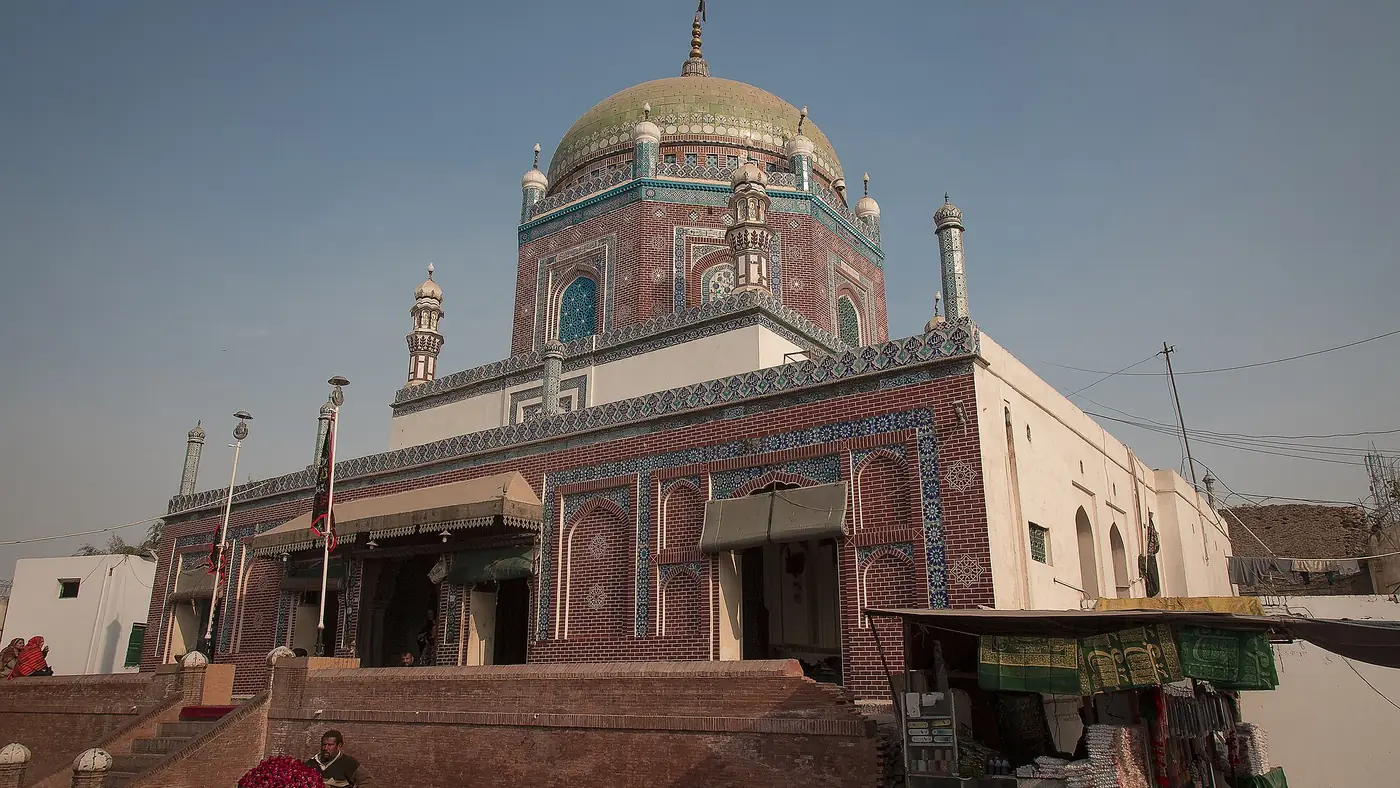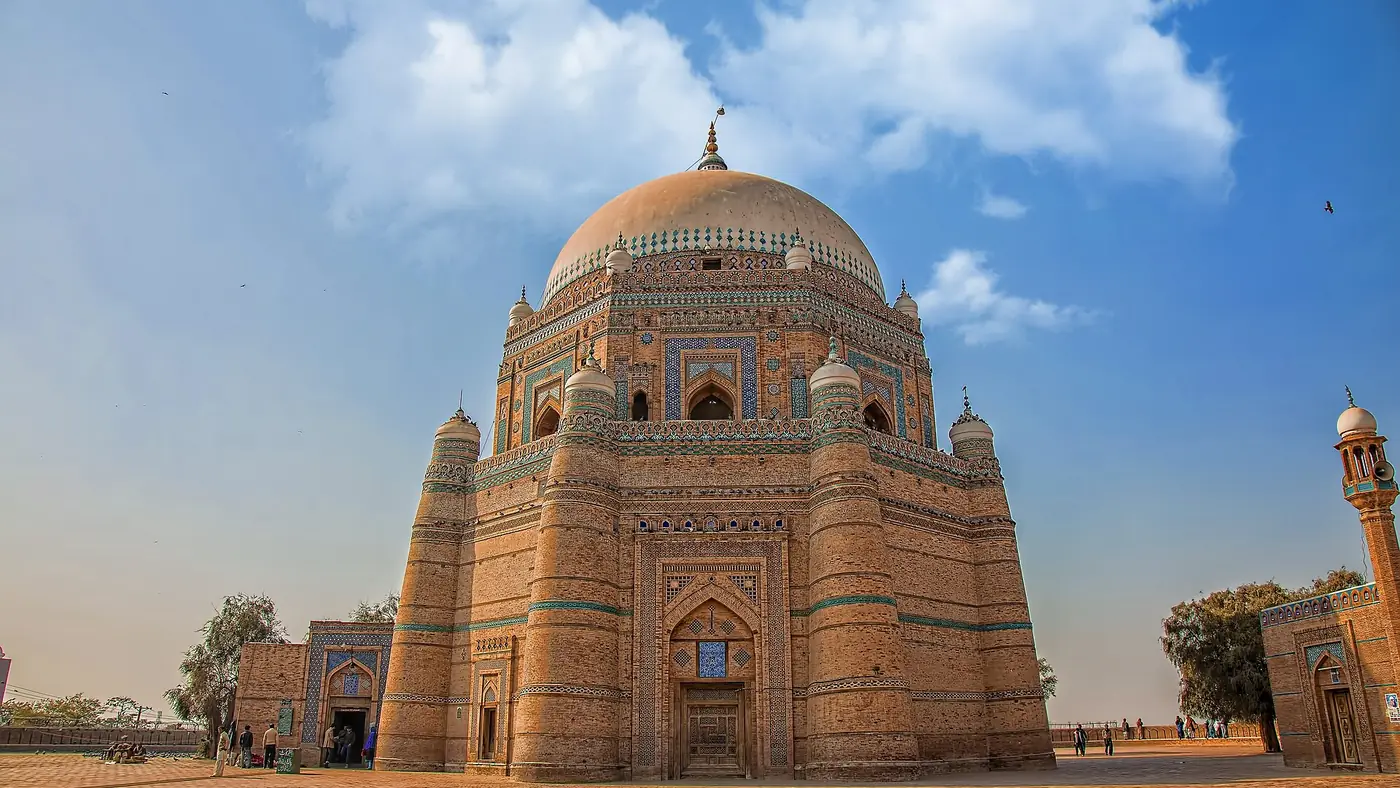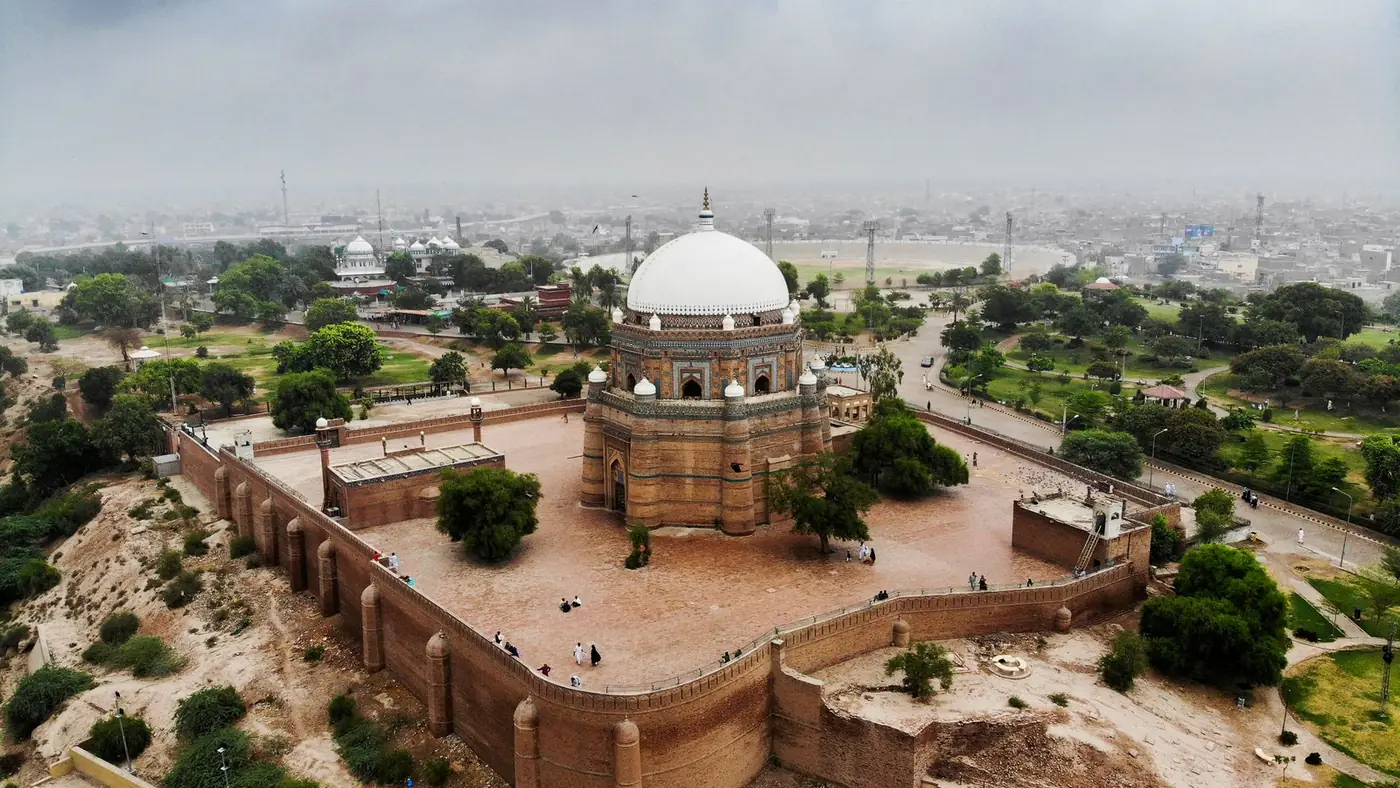
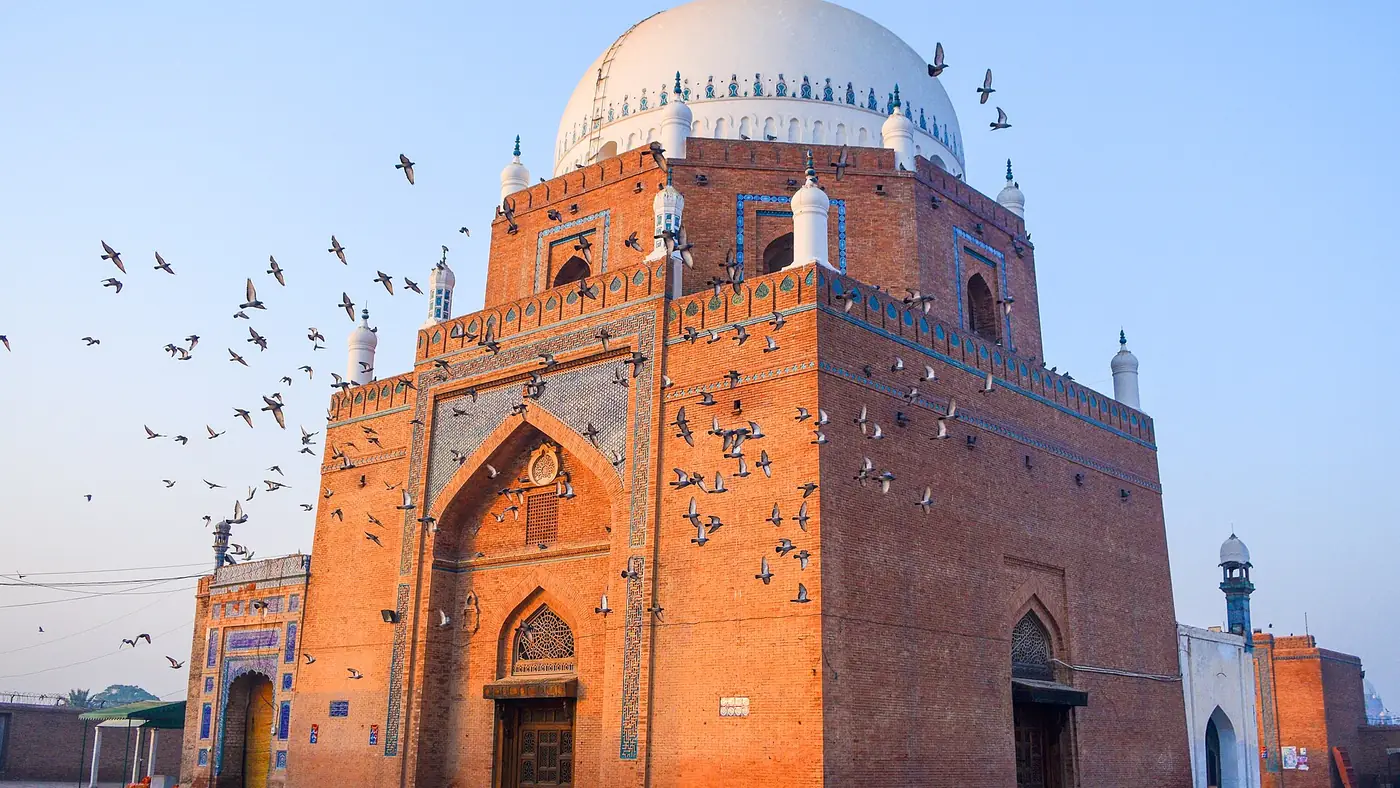
The shrine of Bahauddin Zakariya, at the north-eastern end of Multan's old fort mound, holds the grave of the 13th-century scholar who brought the Suhrawardi Sufi order to South Asia. Completed in 1262, the year he died, it is the oldest of Multan's great shrines and the model that the city's later, larger tombs were built from. Entry is free, and it is a working shrine rather than a museum, so plan the visit around modest dress, shoe removal at the door, and the busier atmosphere of an active place of worship.
This guide covers who Bahauddin Zakariya was, the building's history, the annual urs, how to get there, and how to visit respectfully.
| At a glance | |
|---|---|
| Completed | 1262, the year Bahauddin Zakariya died |
| Order | Suhrawardiyya, first established in South Asia by him |
| Material | Brick, with blue glazed tile and timber |
| Internal size | About 15.8 m square, with an octagonal upper storey and a dome |
| Location | North-eastern end of Qila Kohna Qasim Bagh, central Multan |
| Entry | Free; shoes off, heads covered |
| Annual urs | Held in the Islamic month of Safar; the Gregorian date moves each year |
Who was Bahauddin Zakariya?
Sheikh Bahauddin Zakariya (around 1170–1262) was a Multan-born scholar who studied in the Middle East before returning to found the Suhrawardiyya order in the subcontinent, one of the most influential Sufi lineages in the region's history. He was the grandfather of Shah Rukn-e-Alam, whose own, larger tomb stands at the opposite end of the same fort mound; our Shah Rukn-e-Alam tomb guide covers that shrine separately. Zakariya's teaching and the order he founded shaped religious life across Punjab and Sindh for centuries, and his shrine has been a centre of pilgrimage since shortly after his death.
The building
The shrine was completed in 1262, built in Zakariya's own lifetime and finished around the time of his death, which makes it the earliest of Multan's major domed tombs and the structure later shrines in the region were modelled on. It is a square building, about 15.8 metres across internally, topped by an octagonal upper storey roughly half that height again, and crowned with a white hemispherical dome. The exterior combines brick with bands of blue glazed tile, an ornamental style that became Multan's signature and reappears, on a grander scale, at Shah Rukn-e-Alam's tomb nearby.
The dome and upper storey were damaged by British artillery during the siege of Multan in 1848, part of the same bombardment that reduced the old fort itself to ruins, and were repaired not long afterwards. What stands today is close to eight centuries old in its lower structure, with a rebuilt dome above it.
It remains an active shrine, busier and more overtly devotional day to day than Shah Rukn-e-Alam's tomb, with a steady flow of families and pilgrims through the courtyard rather than the quieter, more monument-like atmosphere next door.
The annual urs
Bahauddin Zakariya's urs, the commemoration of his death, is held each year in Safar, the second month of the Islamic calendar, which means the Gregorian date shifts from year to year rather than falling on a fixed day. Thousands of devotees travel to Multan for it, from within Pakistan and abroad, and the shrine and the surrounding fort mound are at their busiest and most crowded during the days it runs. If you want to see the shrine at its most active, this is when to come; if you want a calmer visit, avoid it, and check locally for the current year's dates rather than relying on a date fixed in advance, since the lunar calendar moves the event by about 10 to 11 days each year.
Getting there
The shrine sits inside Qila Kohna Qasim Bagh, the raised ground where Multan Fort once stood before it was largely destroyed in the 1818 Sikh siege and finished off by British guns in 1848–49. There is no separate ticketed entrance to the mound; you walk up through the gardens and shrine courtyards that now occupy the old fort's footprint, with Bahauddin Zakariya's shrine at the north-eastern end and Shah Rukn-e-Alam's tomb at the other, roughly 400 to 500 metres apart across the mound. Most visitors see both in the same visit. Rickshaw drivers and guides around the old city know the route well.
Allow half an hour to an hour for the shrine itself, longer if you are also seeing Shah Rukn-e-Alam's tomb and the Qasim Bagh gardens in between.
Etiquette
As at any working Sufi shrine in Pakistan:
- Remove your shoes before entering the tomb chamber; there is somewhere to leave them at the door.
- Cover your head if you are a woman, and dress modestly, with arms and legs covered, for men and women alike.
- Lower your voice inside the chamber and keep a respectful distance from people praying at the grave.
- Ask before photographing anyone at prayer, even though photographing the building itself is generally accepted.
- Expect larger crowds on Thursday evenings and Fridays, and considerably larger ones during the urs.
Frequently asked questions
Is there an entry fee for the Bahauddin Zakariya shrine?
No. Like Multan's other shrines, it is free to enter as a working place of worship, not a paid monument.
How old is the Bahauddin Zakariya shrine?
It was completed in 1262, the year the saint died, making it the oldest of Multan's great domed shrines and the model for the later, larger Shah Rukn-e-Alam tomb nearby.
When is the urs of Bahauddin Zakariya held?
It falls in Safar, the second month of the Islamic calendar, so the Gregorian date shifts by roughly 10 to 11 days each year. Check locally for the current year's dates before planning a visit around it.
Can non-Muslims visit the shrine?
Yes. It is open to visitors of any faith, as is standard at Sufi shrines in Pakistan. Dress modestly, remove your shoes at the chamber entrance, and stay respectful of anyone praying.
Is the Bahauddin Zakariya shrine near Shah Rukn-e-Alam's tomb?
Yes. Both stand on the same fort mound, Qila Kohna Qasim Bagh, a few hundred metres apart, and most visitors see them together in a single visit of two to three hours.