The places to visit in Multan centre on the old fort mound, Qila Kohna, where the tombs of Shah Rukn-e-Alam and Bahauddin Zakariya stand above the city beside the Qasim Bagh gardens. Below them lie the walled city's gates, lanes and shrines, the colonial Ghanta Ghar and the Hussain Agahi bazaar, and a little further out the tomb of Shah Shams Tabrez and the Eidgah Mosque. One full day covers the essentials; two lets you take it at Multan's own pace.
Multan has been called the city of saints since Sufi teachers settled here in the 11th and 12th centuries, and its blue-tiled tombs are among the finest buildings in Pakistan. This guide goes through each place, suggests a route, and covers when to go, what to wear at the shrines, and what to eat.
| At a glance | |
|---|---|
| Known as | The city of saints |
| Time needed | One full day for the main sights; two days to see them properly |
| Best months | November to February; October and March are warm but manageable |
| Avoid | May to August, when days can pass 45 °C |
| From Lahore | About 343 km by the M-3 and M-4 motorways, around 4.5 hours |
| By air | Multan International Airport, with domestic flights, mainly from Karachi |
| Getting around | Rickshaws, ride-hailing and the metro bus |
The fort mound: Qila Kohna and Qasim Bagh
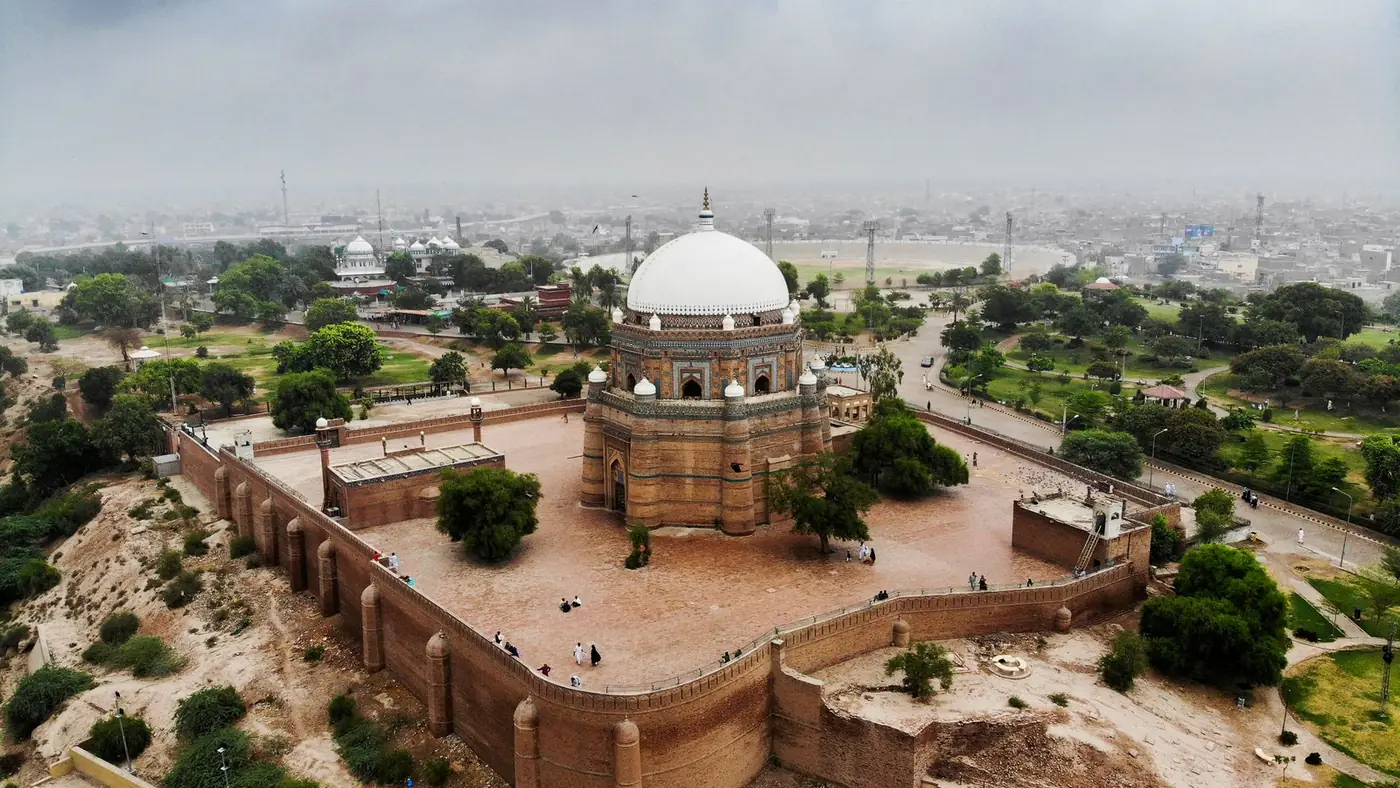
Almost every visit starts on the mound in the middle of the city where Multan Fort once stood. The fort itself is gone: it was badly damaged in the Sikh siege of 1818 and largely destroyed by British guns in 1848–49. What remains is the high ground, stretches of the old walls, and the two great shrines at either end of it.
The mound is now a mix of shrine courtyards, the Qasim Bagh gardens and a modern viewing tower, the Damdama, from which you can see across the whole city. It is the best place to understand Multan's layout before you go down into the lanes.
- Time needed: two to three hours for the mound and both shrines.
- Best time: early morning, before the heat and the crowds, or late afternoon into the evening light.
The tomb of Shah Rukn-e-Alam
The tomb of Shah Rukn-e-Alam, on the south-west side of the mound, is Multan's landmark and one of the great buildings of South Asia. It was built between 1320 and 1324, traditionally by Ghiyath al-Din Tughluq, and is a massive octagon of red brick, banded with timber and blue, azure and white glazed tiles, rising in three tiers to a dome. The whole structure is about 35 metres high.
Inside, the space is open and unexpectedly calm, with the saint's grave surrounded by those of relatives and followers, and one of the earliest carved wooden mihrabs in the region. The tomb is on UNESCO's tentative list of World Heritage Sites.
The shrine of Bahauddin Zakariya
At the north-eastern end of the mound is the shrine of Bahauddin Zakariya, the 13th-century teacher who brought the Suhrawardi Sufi order to South Asia and was Shah Rukn-e-Alam's grandfather. His square tomb, with an octagonal upper storey and a white dome, was built in his lifetime, around 1262, and became the model for early shrines across southern Punjab. British cannon damaged its dome and upper tier in the siege of 1848, and it was repaired soon afterwards.
It is a working shrine, busier and more devotional than Shah Rukn-e-Alam, with families and pilgrims coming and going all day.
The ruins of the Prahladpuri temple
Beside the Bahauddin Zakariya shrine are the ruins of the Prahladpuri temple, dedicated to Narasimha and once one of the most important Hindu temples in the region. It was destroyed in 1992, and restoration ordered by the Supreme Court has not gone ahead. There is little to see beyond the platform and walls, but it is part of the mound's long, layered history.
The walled city and its shrines
Below the mound lies the old walled city, about 1.2 square kilometres of lanes, bazaars and old houses, entered by gates including Delhi Gate, Lohari Gate, Bohar Gate, Haram Gate, Daulat Gate and Pak Gate. Parts of it have been restored, including Haram Gate, the Sarafa Bazaar and the shrine of Musa Pak Shaheed.
Two shrines here are worth seeking out:
- Shah Yousaf Gardez, inside Bohar Gate. The saint came to Multan in the 11th century, and his tomb is unusual: a rectangular, domeless building covered in blue-glazed tiles.
- Musa Pak Shaheed, inside Pak Gate, the shrine of a descendant of Abdul Qadir Jilani, restored in recent years.
The lanes are narrow, crowded and not always signposted. A rickshaw to the gate and a walk inside is the easiest way to see them, and the Walled City Multan authority has run tricycle tours of the historic streets.
- Time needed: two hours or more, depending on how much you wander.
Ghanta Ghar and the Hussain Agahi bazaar
Ghanta Ghar, the clock tower, is the heart of the old commercial city. The building was begun in 1884 and finished in 1888 as the city's municipal offices, in the Indo-Saracenic style, on the ruins of a haveli destroyed in the siege of Multan. The hall was named Ripon Hall and the tower Northbrook Tower, after two viceroys; after 1947 the hall was renamed Jinnah Hall.
Right beside it is Hussain Agahi, Multan's oldest bazaar, named after the Sufi Pir Hussain Agahi. It is crowded, noisy and hugely enjoyable: embroidered and block-printed fabrics, wedding shopping, a dry-fruit market, sweet shops and street food squeezed between the stalls. Prices are low and bargaining is normal.
- Time needed: one to two hours.
- Best time: late afternoon and evening, when the bazaar is at its busiest. Watch your phone and wallet in the crowd.
Shah Shams Tabrez and the Eidgah Mosque
A short ride east of the fort, near the Aam Khas Garden, is the tomb of Shah Shams Tabrez, also known as Shamsuddin Sabzwari, one of Multan's most loved saints. The square, domed tomb is decorated with glazed tiles and draws a steady stream of visitors through the day. The tomb of Hafiz Jamal Multani, an 18th and early 19th-century saint, is nearby, outside Daulat Gate.
North-east of the old city, on the main road towards Lahore, is the Shahi Eidgah Mosque, completed in 1735 under the Mughal governor Nawab Abdul Samad Khan. It is a long prayer hall with seven domes and Multani blue tilework, facing a huge courtyard built for Eid prayers. Under British rule it was used for a time as a courthouse, before being returned as a mosque in 1891.
- Time needed: an hour for each, plus travel.
A one-day route through Multan
- Early morning on the fort mound. Shah Rukn-e-Alam first, while it is cool and quiet, then along the mound to Bahauddin Zakariya and up the Damdama for the view.
- Late morning in the walled city. Down to Bohar Gate for Shah Yousaf Gardez, then through the lanes to Pak Gate and Musa Pak Shaheed.
- Lunch, and a rest through the hottest hours.
- Mid-afternoon at Shah Shams Tabrez and, if you have the energy, the Eidgah Mosque.
- Evening at Ghanta Ghar and Hussain Agahi, for the bazaar at its liveliest and dinner from the stalls and eateries around it.
With a second day, slow everything down, add the craft shops, and go back to the shrines in the evening, when they are at their most atmospheric.
Visiting the shrines respectfully
Multan's shrines are places of worship first and sights second, and visitors of every background are welcome if they follow a few customs:
- Dress modestly. Long sleeves and loose clothes; women should carry a dupatta or scarf to cover their heads.
- Take off your shoes at the entrance to the tomb chambers. There is usually someone to mind them for a small tip.
- Ask before photographing people, especially women and anyone praying, and follow any signs about photography inside.
- Expect crowds on Thursday evenings, traditionally the busiest time at shrines across Pakistan, and huge ones during each saint's urs, held on fixed dates in the Islamic calendar. Check the dates if you want to see an urs, or avoid it.
The same courtesies apply across Pakistan; our travel guide has more on dress, photography and etiquette.
What to eat and buy in Multan
Multan's most famous food is sohan halwa, a dense, rich sweet of wheat, milk, sugar and ghee, studded with nuts and sold in tins all over the city. It is what everyone takes home. In summer, from roughly June to August, Multan is also one of Pakistan's great mango regions, though that is also the hottest time to be here.
The bazaars around Ghanta Ghar and Hussain Agahi are the place for street food, sweets and tea. For crafts, look for Multani blue pottery, the same cobalt-and-turquoise tradition you see on the shrines, and for embroidered fabrics in Hussain Agahi.
When to go, and how long to stay
November to February is the best time, with warm, sunny days that are perfect for walking between shrines. October and March are warm but manageable if you sightsee early and late. From May to August Multan is one of the hottest cities in the country, with days that can pass 45 °C; the record is 50 °C.
In December and January dense fog can close the motorways into Multan, particularly at night and in the early morning, so leave room in your plans.
One full day is enough for the fort mound, the walled city and the bazaar. Two days is better, and Multan also works as the start of a longer south Punjab trip to Uch Sharif and Bahawalpur, which our guide to places to visit in Punjab sets out.
Is Multan worth visiting?
Yes, especially if you care about architecture, history or Sufi tradition. The tomb of Shah Rukn-e-Alam alone is worth the journey, and the combination of great shrines, a living old city and some of the best sweets in Pakistan is hard to match.
It suits travellers who are happy with heat, crowds and bazaars, and who enjoy cities more than scenery. It suits families less well in summer, when the heat makes the long days on foot hard going for children and older parents. If that is you, go in winter, or plan Multan as a day or two within a wider trip; tell us what you have in mind and we will help you shape the route.
Frequently asked questions
What is Multan famous for?
Its Sufi shrines, above all the tombs of Shah Rukn-e-Alam and Bahauddin Zakariya, which give it the name city of saints. It is also famous for blue pottery, sohan halwa, mangoes and its heat.
How many days are enough for Multan?
One full day covers the fort mound, the main shrines, Ghanta Ghar and the Hussain Agahi bazaar. Two days lets you see them at a comfortable pace and add the Eidgah Mosque and the crafts.
What is the best time to visit Multan?
November to February, when days are warm and dry. Avoid May to August, when temperatures regularly reach the mid-40s and higher.
Can non-Muslims visit the shrines in Multan?
Yes. Visitors of all faiths are welcome at the shrines if they dress modestly, cover their heads where asked, remove their shoes at the tomb chambers and behave respectfully.
How far is Multan from Lahore?
About 343 km by the M-3 and M-4 motorways, which takes around four and a half hours in normal conditions. Winter fog can close the motorways for hours at a time.
What should I buy in Multan?
Sohan halwa, Multani blue pottery and embroidered fabrics from the Hussain Agahi bazaar are the classic buys.