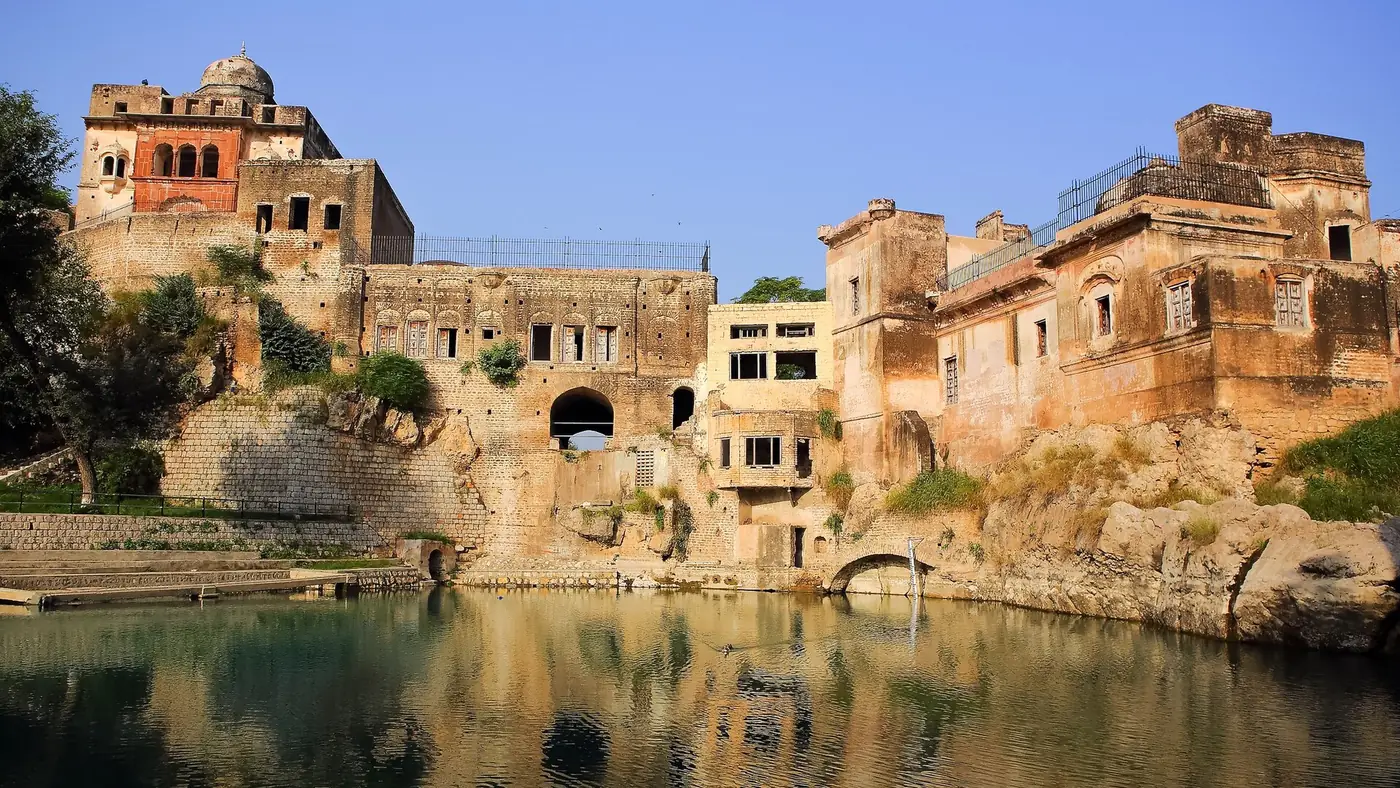
The Katas Raj temple complex is a group of Hindu temples built around a sacred pond at Katas, in the Salt Range near Choa Saidan Shah in Chakwal district, about 24 km off the M-2 at the Kallar Kahar interchange. Hindus believe the pond was formed from the tears of Shiva, and the temples around it date from roughly the 6th to the 10th centuries AD, with later Sikh and Hindu buildings beside them. Entry is free, the site is open in daylight, and an hour to an hour and a half is enough to see it properly.
It is one of the most important Hindu pilgrimage sites in Pakistan, and still a place of worship. This guide covers the legends, what each part of the complex is, the story of the pond, and the practical side of visiting.
| At a glance | |
|---|---|
| Where | Katas, near Choa Saidan Shah, Chakwal district |
| From the M-2 | About 24 km from the Kallar Kahar interchange |
| From Islamabad | About 150 to 160 km, 2 to 2.5 hours |
| From Lahore | About 270 km, around 3.5 hours |
| Entry | Free; carry your CNIC (foreigners, a passport) |
| Hours | Daylight hours; no official timetable is published |
| Time needed | 1 to 1.5 hours |
| Managed by | Evacuee Trust Property Board |
| Best months | October to March |
Where is Katas Raj, and how do you get there?
Katas Raj sits in a fold of the Salt Range at about 2,000 feet, beside the road that runs east from Kallar Kahar to Choa Saidan Shah. From the Kallar Kahar interchange on the M-2, the temples are about 24 km away on a paved road. Choa Saidan Shah is about 6 km further on, and the Khewra Salt Mine about 10 km beyond that.
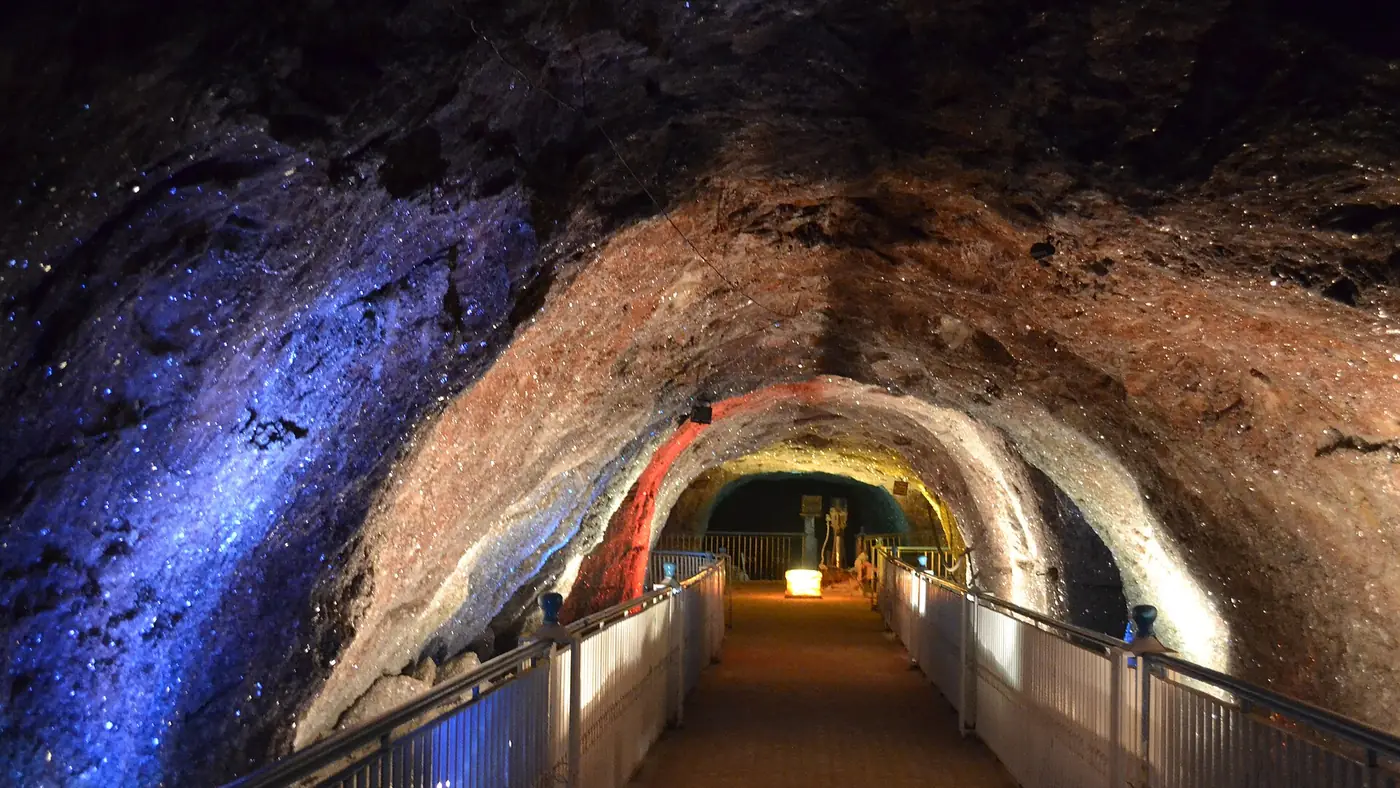
From Islamabad, take the M-2 south and leave at Kallar Kahar. From Lahore, take the M-2 north to the same exit, or leave at Lilla, see Khewra first, and come up through Choa Saidan Shah. Our guide on how to reach Khewra Salt Mine covers both motorway routes and a loop that takes in both sites in a day.
There is no public transport to the complex itself. Come by car, or hire a car and driver for the day.
The legends of Katas Raj
Two stories give Katas its importance.
The first is about Shiva's grief. When his wife Sati died, Shiva wandered the earth inconsolable, and his tears fell to form two sacred pools. Tradition holds that one is the pond at Katas and the other is at Pushkar in India. The name Katas is usually traced to the Sanskrit kataksha, "tearful eyes". Bathing in it, especially on certain holy days, is believed to wash away sins.
The second comes from the Mahabharata. The Pandava brothers are said to have spent part of their twelve years of exile here. In the story most often told at Katas, the brothers came to a pond to drink, and a yaksha, a nature spirit, forbade them until they answered his riddles. Four brothers ignored him and fell dead; the eldest, Yudhishthira, answered every question and won their lives back. Local tradition also credits the Pandavas with building the seven temples of the Satgraha.
A short history of the site
Katas was a sacred place long before the present temples. The oldest structure is the mound of a Buddhist stupa, which tradition dates to the time of the Mauryan emperor Ashoka.
Punjab's archaeology department attributes the Hindu temples to the Hindu Shahi period, roughly the 7th to the 10th centuries. The oldest surviving temple is dated to the late 6th century, and the largest of the Satgraha group to the 10th. Their pointed roofs, trefoil arches and fluted pillars are in the Kashmiri style of the period.
Later centuries added more. In the early 19th century, under Sikh rule, the general Hari Singh Nalwa built a haveli on a small rise overlooking the complex. Katas remained a pilgrimage centre until 1947, when its Hindu community left for India and the complex fell quiet.
The site is protected under the Antiquities Act and managed by the Evacuee Trust Property Board, which looks after non-Muslim religious property in Pakistan. Restoration work began in the mid-2000s, and in December 2024 the Board opened a 36-room residential block for pilgrims.
What to see at Katas Raj
The complex is compact, and you can walk around all of it in an hour. There are few signs explaining the buildings, so it helps to know what you are looking at.
The sacred pond
The pond is the centre of everything. It is small, under three kanals in area, and was once up to 20 feet deep, with clear green water fed by springs. Pilgrims bathe on its steps. Walk round it first to get your bearings.
The Satgraha
The Satgraha, "seven temples", is the oldest group, a cluster of stone temples. They are the finest early architecture at Katas: square shrines on raised platforms, with ribbed domes and carved cornices. They are empty inside and often locked, so ask the caretaker.
The Ram Chandra and Hanuman temples
The Ram Chandra temple stands on the east side of Hari Singh Nalwa's haveli and is no longer in use. The Hanuman temple, at the western end of a high walled enclosure, is still used for worship, and its walls carry painted decoration.
The Shiva temple
The Shiva temple is the main active shrine, with a lingam inside. If worshippers are present, wait until they have finished before entering.
Hari Singh Nalwa's haveli
On a small hill overlooking the complex, Hari Singh Nalwa's haveli is a small rectangular fort-house with a bastion at each corner and a wide arched entrance. It gives the best view over the whole complex. Its roof needs repair, so stay out of any part that is closed off.
The stupa mound and the caves
The remains of the Buddhist stupa are a low mound rather than a building. Across the road from the complex are caves that local tradition links with the Pandavas' exile.
Why the pond has been drying up
Visitors often arrive expecting a deep, clear lake and find the water low. The reason is groundwater. Several large cement plants operate in the area, and for years they drew heavily on the same aquifer that feeds the pond's springs. The pond dried out completely in 2012 and again in 2017.
In 2017 the Supreme Court took up the case on its own motion. In 2018 it ordered the pond refilled, and it closed the case after the cement companies agreed to find another source of water and pay for what they used in the meantime. Since then the pond has been kept filled from boreholes rather than its natural springs, and the level still varies.
In July 2025, flash floods overflowed the pond and brought down sections of the outer boundary wall in three places, but officials reported no damage to the temples themselves. Within days the water had fallen again. What you see depends on the season and the pumping.
Visiting: timings, ticket and etiquette
Entry is free. There is no ticket office. Carry your CNIC, or your passport if you are a foreign visitor, because you may be asked for it at the gate.
Timings. No official timetable is published. The site is open through daylight hours; arrive by mid-afternoon so there is time to find the caretaker and see the temples in good light.
Guides and caretakers. A caretaker or guide may walk round with you and open the locked temples. Some visitors are told they must be accompanied to enter any temple. There is no fixed fee; give what you think is fair at the end.
How to behave:
- Take off your shoes before entering any temple.
- Dress modestly; women may want a scarf.
- Don't swim, wash or throw anything into the pond. It is a place of worship.
- Ask before photographing worshippers, and don't photograph inside the active shrines without permission.
- Keep your voice down around the Shiva and Hanuman temples.
Facilities are very basic. Bring water and snacks, and use the toilets at the Kallar Kahar service area before you leave the motorway.
When to go
October to March is the best time, with mild days in the Salt Range. The summer months are hot, and the stone courtyards have little shade, so if you come between May and September, arrive early.
The busiest time is Maha Shivratri, in February or March, when Hindu pilgrims come from across Pakistan and, under a long-standing agreement, a group of pilgrims from India. A second group of Indian pilgrims is permitted around Kartik, in November and December. At these times the complex is at its busiest. If you are visiting as a tourist, a quieter date gives you more room, and if you do want to come for the festival, check beforehand whether general visitors are being admitted.
Is Katas Raj worth visiting?
Yes, especially if you are already going to Khewra, which is half an hour away. It is one of the few places in Pakistan where early medieval Hindu temples stand beside shrines still in use, and the setting, stone temples around a green pond in the dry Salt Range hills, is striking.
Be realistic about what you will find. The temples are small, many are empty and locked, there are almost no information boards, and the pond may be low. Read a little before you go, or you will see a collection of old buildings without knowing what they are. Families with young children will find it a short stop; people interested in history and religion will want the full hour and more.
For most visitors the best plan is a day in the Salt Range: Katas Raj in the morning, then the Khewra Salt Mine in the afternoon. For help shaping a longer trip, see our trip planning page.
Frequently asked questions
Is there an entry fee at Katas Raj?
No. Entry to the Katas Raj complex is free. Carry your CNIC or passport, and give a small amount to any caretaker or guide who opens the temples for you.
What are the Katas Raj timings?
No official timetable is published. The complex is open through daylight hours; arrive by mid-afternoon to be sure of getting into the temples.
Where is Katas Raj located?
In Chakwal district, Punjab, in the Salt Range near Choa Saidan Shah, about 24 km from the Kallar Kahar interchange on the M-2 motorway.
Why is the Katas Raj pond sacred?
Hindu tradition holds that it was formed from the tears Shiva shed after the death of his wife Sati. The Mahabharata also links it with the Pandavas' exile.
Why did the Katas Raj pond dry up?
Heavy groundwater use by nearby cement factories lowered the water table, and the pond dried completely in 2012 and 2017. After a Supreme Court case in 2018 it has been kept filled from boreholes, but the level still varies.
How far is Katas Raj from Khewra Salt Mine?
About 20 km, roughly half an hour by car, via Choa Saidan Shah. The two are easily combined in one day.