Frere Hall in Karachi is best known for two things that have nothing to do with why it was built: the unfinished ceiling mural the artist Sadequain painted inside it in the 1980s, and the second-hand book bazaar that fills its lawns every Sunday. The hall itself, a Venetian-Gothic building from the 1860s, is free to walk around, and its gardens are one of the calmer green spaces in central Karachi.
This guide covers the ceiling, the book bazaar, the library, and what else sits nearby.
| At a glance | |
|---|---|
| Where | Abdullah Haroon Road, between Clifton and Saddar |
| Built | 1863 to 1865 |
| Entry | Free to the gardens; the hall itself keeps its own hours |
| Sadequain ceiling | Inside the hall, painted 1986–87, left unfinished at his death |
| Sunday book bazaar | Every Sunday, on the lawns |
| Library | Liaquat National Library, on the ground floor |
| Best time | Late afternoon into the evening, when the gardens are busiest |
The Sadequain ceiling
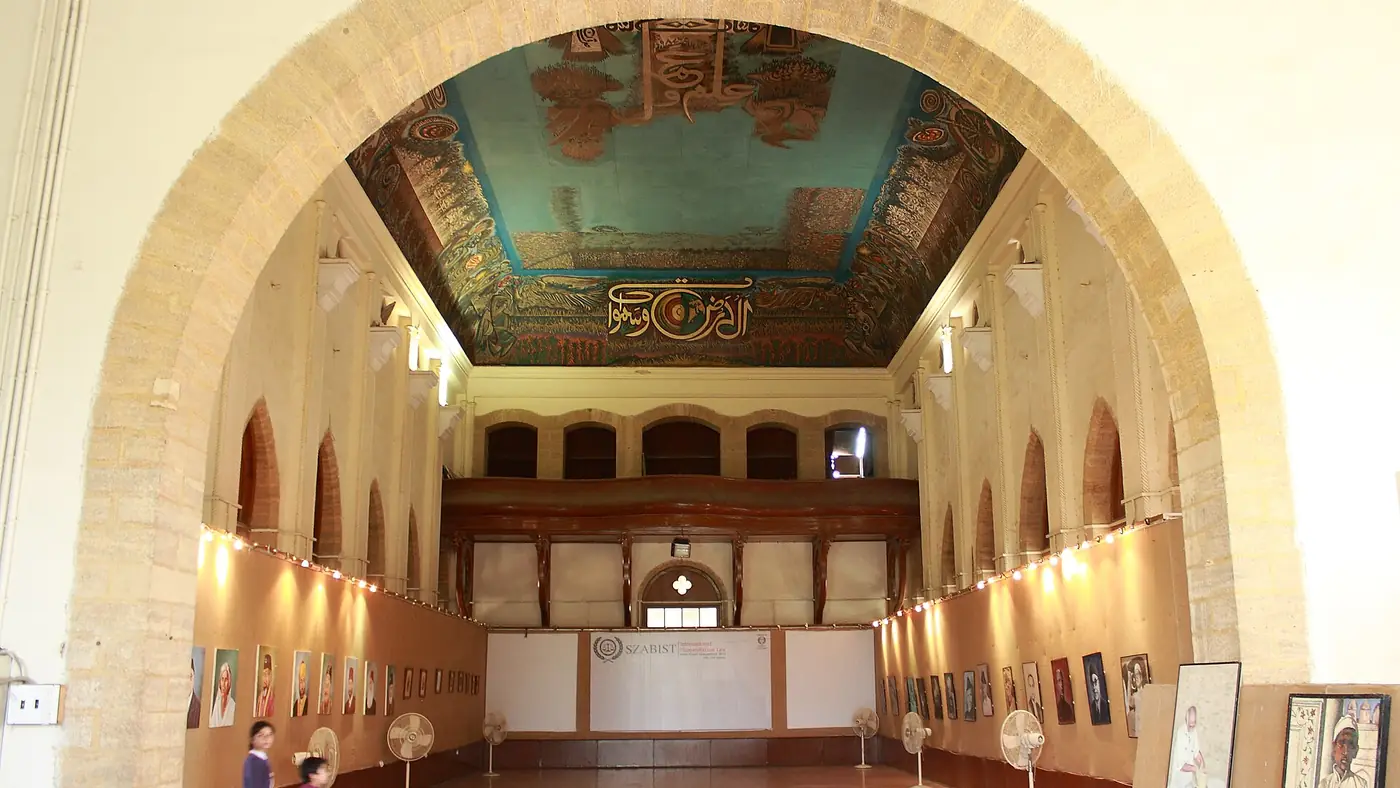
The reason most people specifically seek out Frere Hall is the ceiling mural inside the hall, painted by Syed Sadequain Ahmed Naqvi, one of Pakistan's best-known modern artists. He began the work, titled Arz-o-Samawat ("Earth and the Heavens"), in 1986, working in his distinctive calligraphic style across the underside of the hall's dome. He died in February 1987 before finishing it, and the incomplete sections were left as they were rather than painted over or completed by another hand.
The result is unusual among the city's public art: a large-scale ceiling piece that is explicitly unfinished, and treated as more powerful for being so. Access to the hall itself, where the mural is, has not always been consistent, so check locally on the day whether it is open before you plan a visit specifically to see it.
The Sunday book bazaar
Every Sunday, the lawns around Frere Hall fill with stalls selling second-hand books, from well-known publishers' overstock to individual booksellers' personal collections, in English and Urdu, covering everything from textbooks and novels to old magazines. It is one of Karachi's genuine long-running traditions, popular with students, collectors and families out for a slow browse. The bazaar has had its interruptions over the decades, including a suspension after a security incident near the hall in the early 2000s, but it has kept coming back, and it remains the busiest the grounds get all week.
Go in the morning or late afternoon rather than the middle of a hot day, and bring cash; card payment is not the norm here. Bargaining is expected and part of how the bazaar works.
Liaquat National Library
The ground floor of Frere Hall has held a public library since not long after the building opened, today known as the Liaquat National Library, with a substantial collection of books available to browse and, for members, to borrow. It keeps its own hours, generally in the daytime and separate from the general opening of the grounds, and it is a quiet, unhurried place to sit even if you are not there to research anything in particular.
The gardens
The grounds around the hall, known as Bagh-e-Jinnah, are laid out with old trees, lawns and paved walks, and they are open to the public through the day and into the evening. They fill up in the late afternoon and evening once the heat has eased, with families, joggers and people simply sitting out, and this is generally the most pleasant time to visit. The gardens are free to enter regardless of whether the hall itself, and its ceiling, are open that day.
History of the building
Frere Hall was built as a memorial to Sir Henry Bartle Frere, a former commissioner of Sindh, and funded through a combination of public subscription and government and municipal contributions. Construction ran from 1863 to 1865, in a Venetian-Gothic style using local Karachi limestone with contrasting bands of Bholari stone and Jungshahi sandstone, topped by an octagonal tower. It was built as a general public hall for the city rather than for any single purpose, which is part of why it has housed a library, a museum and, later, an art gallery over its history.
The main hall has also served over the decades as an exhibition and event space, hosting art shows, concerts and civic functions in addition to its library and gallery. That mixed use is part of why access to different parts of the building varies: the grounds are consistently open, the library keeps set hours, and the main hall with the ceiling mural depends on what is being held there that day.
Getting there and nearby buildings
Frere Hall sits on Abdullah Haroon Road, between Saddar and Clifton, close to several of Karachi's other colonial-era buildings. It is an easy stop to combine with a wider look at the city's heritage architecture.
- Ride-hailing or your own car, with roadside parking available around the grounds, though it fills up on Sunday for the book bazaar.
- Nearby, within a short drive, are the Mohatta Palace Museum in Clifton and the old city's Empress Market and National Museum, both covered in our list of places to visit in Karachi.
- Pair it with an early evening at Sea View, a short drive further into Clifton, to end the day at the water.
Is Frere Hall worth visiting?
Yes, and it costs nothing to walk the gardens and see the outside of the building, which makes it an easy addition to a Karachi day rather than something that needs its own trip. The Sadequain ceiling is the real draw for anyone with a specific interest in Pakistani art, but access to it can be inconsistent, so treat it as a bonus rather than a guarantee.
It suits a slow afternoon more than a tightly timed sightseeing stop, and Sunday adds the book bazaar for anyone who enjoys browsing. If your time in Karachi is short, the gardens and the outside of the hall are enough for a worthwhile half hour; allow longer on a Sunday, and check ahead if seeing the mural is the reason you're coming. Our trip planning page is the place to start if Karachi is part of a longer trip.
Frequently asked questions
Is Frere Hall free to visit?
The gardens are free to enter. The hall itself, where the Sadequain ceiling is, keeps its own access, which has not always been consistent, so it is worth checking locally before a visit built specifically around seeing it.
When is the Sunday book bazaar at Frere Hall?
Every Sunday, on the lawns around the hall. Go in the morning or late afternoon to avoid the midday heat, and bring cash.
What is the Sadequain ceiling at Frere Hall?
A large mural painted by the artist Sadequain inside the hall's dome between 1986 and 1987, left unfinished at his death and preserved that way rather than completed.
Is there a library inside Frere Hall?
Yes, the Liaquat National Library occupies the ground floor, with its own opening hours separate from the grounds.
What else is near Frere Hall in Karachi?
Mohatta Palace Museum and the Abdullah Shah Ghazi shrine in Clifton, and the old city's Empress Market and National Museum, all within a short drive.