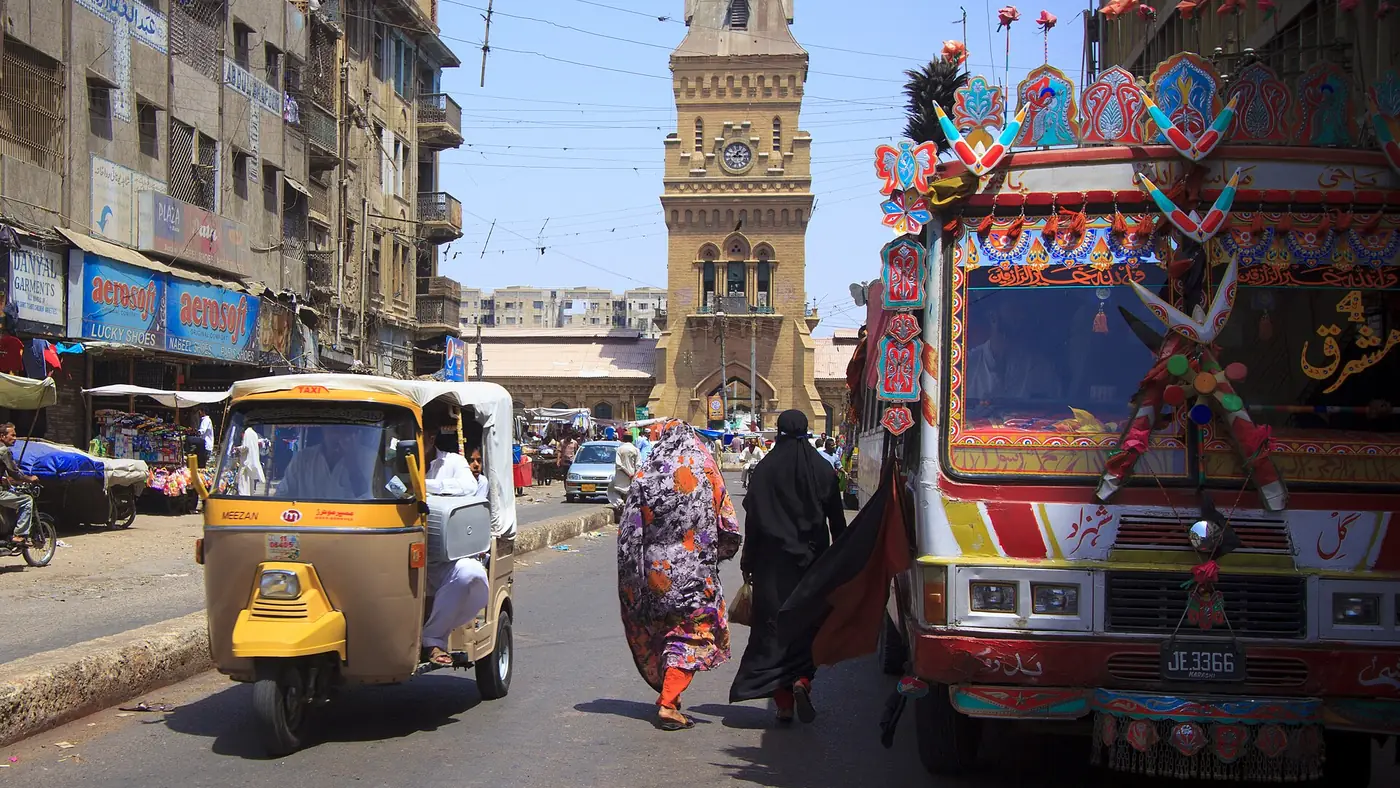
Empress Market is Karachi's best-known covered market, a red-brick Indo-Gothic building in Saddar built in the 1880s, topped by a 140-foot clock tower. It still works as a real market today, selling spices, dry fruit, meat, fish, vegetables, household goods and pets, and it is busiest, and most photogenic, in the morning.
This guide covers the market's history, what it sells now, and how to shop it comfortably in one of Karachi's most crowded neighbourhoods.
| At a glance | |
|---|---|
| Where | Saddar, central Karachi |
| Built | 1884 to 1889 |
| Named for | Queen Victoria, Empress of India |
| Clock tower height | 140 feet |
| Sells today | Spices, dry fruit, meat, fish, produce, household goods, pets |
| Busiest | Weekday mornings |
| Time to allow | 30 to 60 minutes |
The history of Empress Market
Empress Market was built between 1884 and 1889, with its foundation stone laid by James Fergusson, then governor of Bombay, and named for Queen Victoria in her role as Empress of India. It was designed in an Indo-Gothic style, with vaulted roofs and cusped arches around a central courtyard, and its clock tower, rising 140 feet, was built to be seen from a distance across the growing city.
The site was not chosen at random. It stands where sepoys were executed following the failed uprising against British rule in 1857, and choosing this spot for a grand public market has long been read as a deliberate move to prevent any memorial being raised there for the men who died. That history sits underneath the market's everyday business, largely unmarked, and is worth knowing as you walk through.
The original building held around 280 shops in four galleries around the courtyard. Over the following decades the market grew well beyond that, both inside its walls and in the informal stalls that spread around it.
What the market sells today
Empress Market functions as a full-scale wholesale and retail market, organised loosely by section:
- Spices and dry fruit, some of the most visited stalls, selling everything from everyday cooking spices to seasonal dry fruit in bulk.
- Fruit and vegetables, with produce arriving fresh through the morning.
- Meat, poultry and fish, in dedicated sections, not for the squeamish but an honest look at how the city is fed.
- Household goods, textiles and stationery, spread through the galleries and the surrounding lanes.
- A pet section, selling birds and other animals; this part of the market has drawn criticism over the sale of protected and exotic species, and animal welfare groups have raised concerns about conditions there. If animal welfare matters to you, this section is worth skipping.
The 2018 anti-encroachment drive
For decades, thousands of informal stalls, carts and shopfronts had spread across the streets and pavements around Empress Market, well beyond its original building. In November 2018, acting on a Supreme Court order, the Karachi Metropolitan Corporation demolished more than a thousand of these structures around the market in a single operation, part of a wider anti-encroachment drive that removed thousands of informal shops and stalls across the city. It displaced a large number of vendors and drew both criticism, over the loss of livelihoods with little notice, and support, from those who wanted the historic building and the streets around it restored to something closer to their original state.
The market today is calmer and more open than it was before 2018, with more of the original architecture visible from the street, though vendors have since returned in smaller numbers to parts of the surrounding lanes. Expect a working market rather than a museum piece: busy, loud and, in the meat and produce sections especially, not always tidy.
Karachi's civic authorities have periodically announced plans to redevelop the area around Empress Market into a more organised, pedestrian-friendly space, in the same spirit as similar proposals for Burns Road nearby. As with those plans, timelines have moved more than once, so treat any redevelopment you read about as a possibility rather than something already finished.
Tips for shopping at Empress Market
- Go in the morning, when the produce is freshest and the crowds, while still real, are more manageable than in the afternoon.
- Keep your bag in front of you and stay alert to your surroundings; Saddar is one of the most crowded parts of the city, and pickpocketing happens in dense markets like this one.
- Bargain, especially for spices, dry fruit and textiles; prices are rarely fixed.
- Bring cash. Card payment is not the norm in most of the market's stalls.
- Wear closed shoes, particularly in the meat and produce sections, where the floors can be wet and uneven.
- Go with a plan if you want to buy something specific, spices or dry fruit especially, since the market is large and it is easy to spend an hour without finding what you came for.
Getting there
Empress Market sits in the heart of Saddar, central Karachi, close to the National Museum of Pakistan, Merewether Tower and the old city's other colonial-era buildings, and a short drive from Burns Road. It pairs naturally with a morning of old-city sightseeing.
- Ride-hailing is the easiest way in and avoids the parking search in Saddar's crowded streets.
- Your own car can usually find parking nearby, though the roads around the market are congested through the day.
- Combine it with the National Museum and Burns Road for a full old-city morning and lunch, as covered in our list of places to visit in Karachi.
Is Empress Market worth visiting?
Yes, for anyone who wants to see a working piece of Karachi's history rather than a restored, sanitised version of it. The building itself, the clock tower and the atmosphere of a genuine city market make it worth thirty minutes to an hour, whether or not you buy anything.
It suits people who enjoy busy, unpolished markets more than anyone looking for an easy, air-conditioned shopping trip; it is loud, crowded and, in parts, unglamorous. Go in the morning, keep valuables secure, and treat it as a stop on a wider old-city morning rather than a destination on its own. Our trip planning page is the place to start if Karachi is part of a longer trip.
Frequently asked questions
What is Empress Market famous for?
Its Indo-Gothic architecture and 140-foot clock tower, built in the 1880s and named for Queen Victoria, and for still functioning as a real market today, selling spices, produce, meat and household goods.
Is Empress Market still open after the 2018 demolitions?
Yes. The main market building is open and busy as usual; the 2018 operation removed informal stalls that had spread onto the streets around it, not the market itself.
What is the best time to visit Empress Market?
Weekday mornings, when produce is freshest and the crowds are more manageable than later in the day.
Is it safe to shop at Empress Market?
It is a normal, busy city market, but Saddar is crowded and pickpocketing happens, so keep your bag in front of you and stay alert, as you would in any dense market.
What can you buy at Empress Market?
Spices, dry fruit, fresh produce, meat and fish, household goods and textiles, and a pet section that is best skipped if animal welfare is a concern for you.