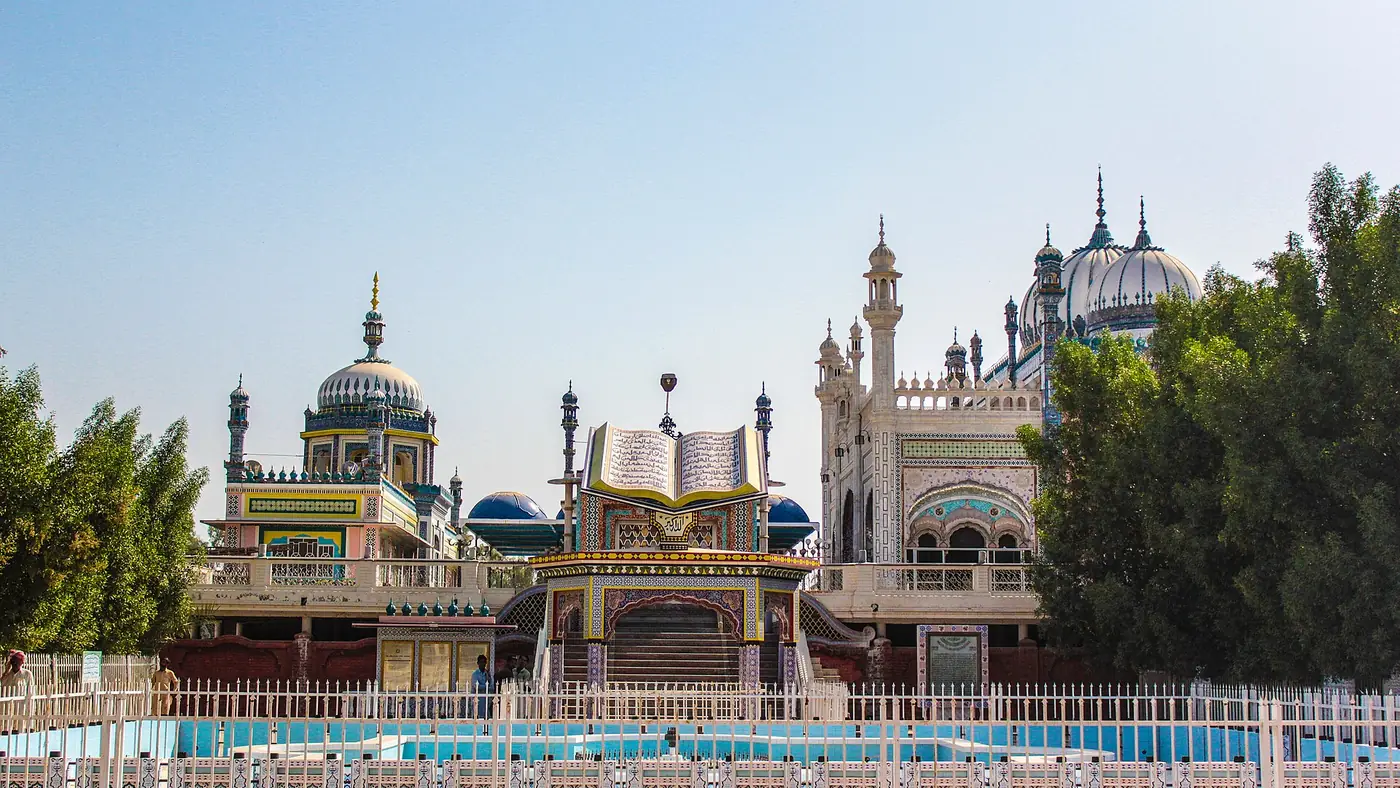
Bhong Mosque is a working village mosque in Rahim Yar Khan district, about 50 km south-west of Rahim Yar Khan city, that took nearly fifty years to build and won the Aga Khan Award for Architecture in 1986. It stands out for how far its decoration goes beyond an ordinary mosque: marble, mirror work, carved teak, onyx, tilework and gold-topped domes, built up over decades by craftsmen brought in from across Pakistan and India. This guide covers its history, its architecture, how to get there from Sadiqabad, and how to visit it properly.
| At a glance | |
|---|---|
| Location | Bhong village, Sadiqabad tehsil, Rahim Yar Khan district |
| Built | 1932 to 1982, close to fifty years |
| Recognition | Aga Khan Award for Architecture, 1986 cycle |
| Status | An active mosque; the call to prayer is still made five times a day |
| Nearest town | Sadiqabad, reached via Ahmadpur Lamma |
| Entry | Free; a working place of worship, so dress and behave accordingly |
The history behind Bhong Mosque
The mosque was commissioned in 1932 by Rais Ghazi Mohammad, a local landlord, as the centrepiece of a palace-style compound that also included a smaller mosque, a madrasa and rooms for students. Construction and decoration continued for close to fifty years, officially completed in 1982, though ornamental work is said to have carried on beyond that date. Master masons and craftsmen came from across Pakistan and India for the project, including artisans from Rajasthan and calligraphers and painters from Karachi, working alongside local builders over the decades.
In 1986 the mosque won the Aga Khan Award for Architecture, the prize given every three years to projects that show excellence across the Muslim world. The jury's citation described Bhong as enshrining "the popular taste in Pakistan with all its vigour, pride, tension and sentiment," noting how its use of signs and symbols captured an architecture in transition. It remains one of relatively few sites in Pakistan to hold the award, alongside better-known projects such as Islamabad's Faisal Mosque.
What makes the architecture unusual
Bhong Mosque is often described as eclectic, and that is deliberate rather than accidental: its design draws on Persian, Andalusian and Ottoman elements alongside Lahore's Mughal-era tradition and even some Western colonial detailing, brought together on a scale most village mosques never attempt. The result is a building covered almost everywhere in decoration rather than restrained ornament in a few places.
Materials used include:
- Marble, sourced from both Multan and India, covering large areas of the interior and exterior
- Ivory, onyx and coloured glass, worked into detailed inlay and fittings
- Carved teak doors, some of the mosque's most striking individual features
- Mirror work and fresco painting, covering ceilings and wall panels
- Glazed tilework and calligraphy, running through the interior spaces
- Industrial-era materials, including terrazzo, artificial stone and wrought iron, used mainly in the exterior areas, a sign of the decades the project spanned
The domes are described as azure and gold, with colourful minarets that stand out sharply against the flat, dry plain around Bhong village, on the edge of the Cholistan desert.
How to reach Bhong Mosque
Bhong Mosque sits in a rural part of Rahim Yar Khan district, roughly 50 km south-west of Rahim Yar Khan city. The most practical route for most visitors is via Sadiqabad, the nearer town on the main highway network. From Sadiqabad, take the road toward Kashmore as far as Ahmadpur Lamma, then follow the road that branches west to Bhong village. The road is a normal rural highway rather than a difficult one, but it is a village road rather than a fast route, so allow more time than the distance alone suggests.
There is no scheduled public transport running directly to the mosque. Visitors typically arrive by private car or hired taxi from Sadiqabad or Rahim Yar Khan, and some travel by local bus as far as the nearest town before continuing by other means. If you're combining this with other South Punjab travel, our trip planning page can help build the wider route.
Visiting etiquette
Bhong Mosque is not a museum piece; it is a working mosque where prayers are still called five times a day, and it should be treated as such.
- Dress modestly. Cover shoulders and knees, and women should carry a scarf to cover their hair inside.
- Time your visit around prayer times if you want to look around freely; avoid arriving right at a prayer call.
- Remove your shoes before entering any prayer area, as at any mosque.
- Ask before photographing people, particularly women, and be sensitive about photographing anyone at prayer.
- Keep your voice down and avoid loud group photography sessions inside the main prayer hall.
- A respectful donation, if you wish to make one, is generally welcomed at a site that depends on local upkeep, but is never expected.
Photography
Photography of the building's exterior and interior decoration is generally accepted, given the mosque's reputation as an architectural landmark and its history of press and documentary coverage. The same courtesy that applies to any mosque applies here: photograph the architecture freely, but ask before photographing worshippers, and put the camera away during prayer times out of respect for people there to worship rather than to be photographed.
Is Bhong Mosque worth the detour?
For anyone interested in Pakistani architecture, yes, and it is unusual enough that photographs rarely prepare visitors for the density of decoration in person. For a general family trip through South Punjab, it is a worthwhile stop if your route already passes near Sadiqabad or Rahim Yar Khan, rather than a destination to build an entire trip around on its own, given how remote the village is from the region's larger tourist stops like Multan and Bahawalpur.
Frequently asked questions
Where exactly is Bhong Mosque?
In Bhong village, Sadiqabad tehsil, Rahim Yar Khan district, about 50 km south-west of Rahim Yar Khan city, reached via Sadiqabad and Ahmadpur Lamma.
Why did Bhong Mosque win the Aga Khan Award?
It won in the 1986 award cycle for translating traditional craft techniques and materials into a building on an unusually ambitious scale for a village mosque, and for what the jury described as its vivid expression of popular taste in Pakistani architecture.
How long did it take to build Bhong Mosque?
Close to fifty years, from 1932 to its official completion in 1982, with decoration reportedly continuing beyond that date.
Is Bhong Mosque still an active mosque?
Yes. It functions as a normal working mosque, with the call to prayer made five times a day, alongside being a recognised architectural landmark.
Is there an entry fee for Bhong Mosque?
No, it is a mosque rather than a paid heritage site. Visitors should dress and behave as they would at any working mosque.
Can non-Muslim visitors go inside Bhong Mosque?
Mosques in Pakistan generally welcome respectful visitors of any faith to view the architecture, outside of prayer times, provided modest dress and normal mosque etiquette are observed. If in doubt, ask locally on arrival.