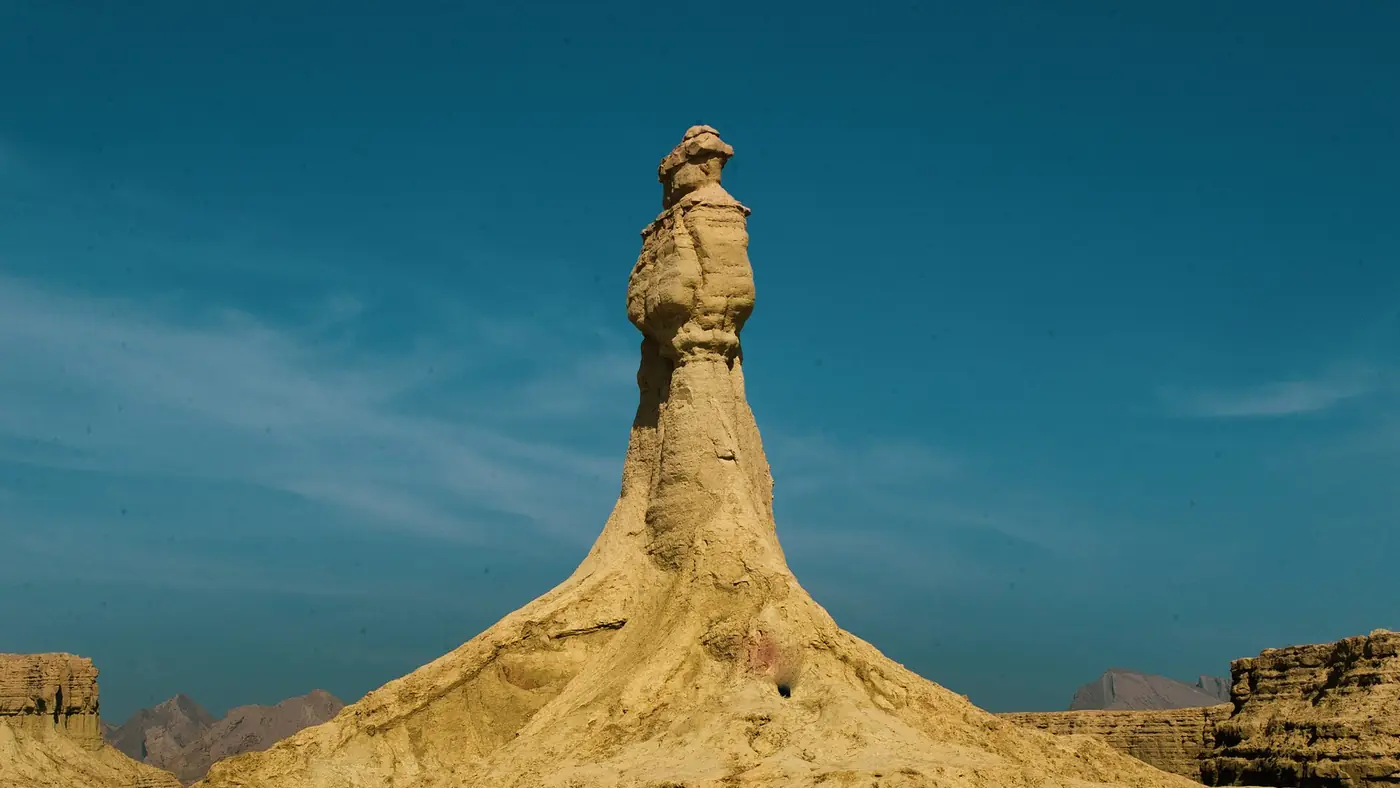
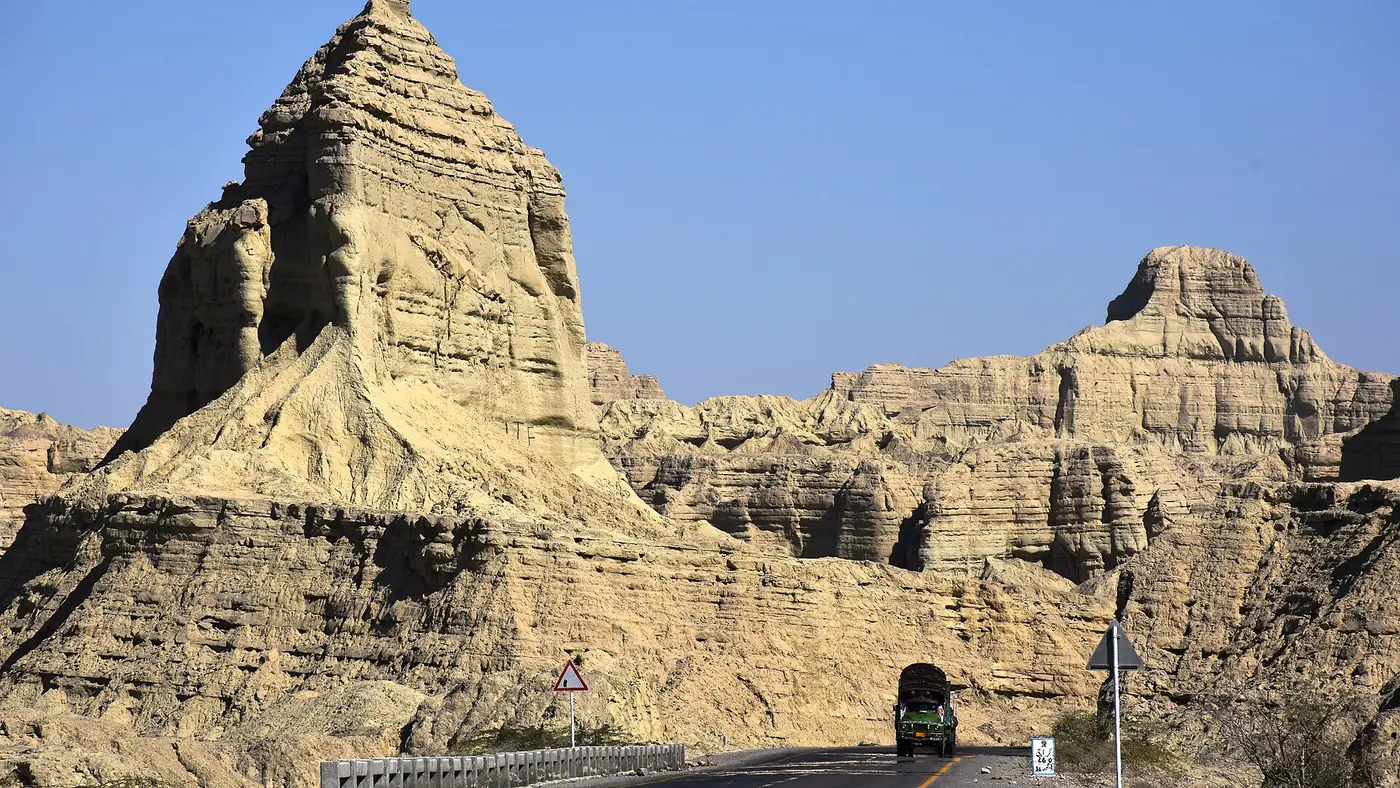
The Balochistan Sphinx, also called the Lion of Balochistan, is a natural rock formation on the Makran Coastal Highway in Hingol National Park, a little before the Princess of Hope as you drive west from Kund Malir towards Buzi Pass. It is not carved by anyone. Wind and rain have worn a ridge of soft clay into a shape that, from the right angle on the road, looks unmistakably like a crouching lion with a raised head. You see it from the highway itself; no side trip or ticket is needed.
This guide covers exactly where to stop for it, how a natural hill came to look like a sphinx, what the viewpoint is like, and how to combine it with the Princess of Hope without adding much to a day at Kund Malir.
| At a glance | |
|---|---|
| What | A natural clay ridge eroded into a shape resembling a crouching sphinx |
| Where | Makran Coastal Highway (N-10), Hingol National Park, a few km before the Princess of Hope |
| From Kund Malir | Roughly 20 to 25 km west, on the way to Buzi Pass |
| From Karachi | About 260 km, 4 to 4.5 hours by road |
| Viewing | From the highway shoulder; no path or entry point |
| Time needed | 10 to 20 minutes |
| Facilities | None; nearest food and toilets are at Kund Malir |
Where to stop for the Sphinx
Driving west from the Kund Malir turning, the highway leaves the beach and climbs into the badlands that lead up to Buzi Pass. This is where the clay hills the whole area is known for begin: ridges, fins and towers worn into shapes by the wind. The Sphinx sits on one of these ridges on the inland side of the road, and you reach it before the Princess of Hope, which stands a little further on towards the pass.
There is no car park, signpost or marked pull-off. Most visitors spot the shape from the moving car, slow down and pull onto the shoulder where it is safe to do so. A few things make it easier to find:
- Save the location on an offline map before leaving Karachi. Mobile signal on this stretch is patchy, and a map that needs data will not load when you need it.
- Watch the ridge on your right once you are 15 to 20 minutes past Kund Malir. The profile changes as you move, and the sphinx-like silhouette only holds from certain angles.
- If you reach the Princess of Hope, you have gone slightly too far. The Sphinx sits a short way back towards the beach.
Our guide to driving from Karachi to Kund Malir has the full route, fuel stops and timings for the road that gets you here.
How did the hill come to look like a sphinx?
The formation is part of the same badlands geology that produced the Princess of Hope and the wider clay-hill scenery around Hingol National Park. The rock here is soft clay and silt, deposited over millions of years and pushed up as the land rose. It is far easier to erode than granite or limestone, so wind, occasional heavy rain and the annual cycle of wetting and drying have cut it into ridges, gullies and freestanding pillars.
The Sphinx is simply one ridge where that erosion has left a head-and-body outline that, seen from the road, resembles a crouching lion. The name and the attention it gets are recent: the shape was largely unknown outside the immediate area until the Makran Coastal Highway opened in 2004 and made this stretch of coast an easy drive from Karachi for the first time.
You may come across claims online that the formation is carved or man-made, sometimes linked to speculative theories about a lost ancient civilisation. There is no credible evidence for this. Geologists and the mainstream sources that have looked at it explain it the same way as the Princess of Hope and the other pinnacles nearby: natural erosion of soft clay, nothing more, though that is remarkable enough in itself.
Viewing it safely
The road at this point runs through hills with bends, and traffic includes fast coaches and fuel tankers heading to and from Gwadar. The formation itself is not something you walk to; you view it from the highway.
- Pull completely off the carriageway before you stop, and use your hazard lights.
- Keep everyone off the road, especially children, while you look and take photographs. Drivers on this stretch are not expecting pedestrians.
- Don't reverse or stop suddenly if you spot it late. If you miss the angle, it is easier to see it properly on the way back than to stop hard on a bend.
- A zoom lens or a phone's telephoto setting helps. The shape is set back from the road and reads best as a tight, isolated shot rather than a wide view of the hillside.
- There is no shade and nothing to buy here. Bring water if you plan to linger, and don't expect toilets closer than Kund Malir.
Combining it with the Princess of Hope
Because the Sphinx and the Princess of Hope sit within a few kilometres of each other on the same stretch of highway, almost everyone sees both in the same stop. The Sphinx costs you little extra time: slow down, look, photograph, and carry on to the Princess of Hope viewpoint further along. Our guide to the Princess of Hope covers that formation in detail, including the short climb some visitors make on the slope below it and the best light for photographs.
Together, the two stops add roughly an hour and a half to a day based at Kund Malir, once you allow for the extra distance and the time to pull over safely at each. That is manageable with an early start from Karachi, and it turns a beach day into a proper look at the badlands that make Hingol National Park unlike anywhere else within reach of the city.
Is it worth the stop?
On its own, no one drives four hours from Karachi just for the Sphinx. As an addition to a Kund Malir day, though, it costs almost nothing beyond a careful stop on the shoulder, and it is one more example of how strange this stretch of coast looks compared with anywhere else in Pakistan.
Skip it if you are already running late for the drive back before dark, or if traffic and light make a safe stop difficult that day. There will be another chance; the hill is not going anywhere. If you would like help fitting the Sphinx and the Princess of Hope into a wider trip along the coast, our trip planning page is the place to start.
Frequently asked questions
Where exactly is the Balochistan Sphinx?
On the Makran Coastal Highway in Hingol National Park, a few kilometres before the Princess of Hope as you drive west from Kund Malir towards Buzi Pass. You view it from the road; there is no separate entrance.
How far is the Balochistan Sphinx from Kund Malir?
Roughly 20 to 25 km west along the highway, a drive of about 20 to 25 minutes. It sits just before the Princess of Hope, which is about 25 km from Kund Malir.
Is the Balochistan Sphinx man-made?
No credible evidence supports that. It is a natural clay ridge shaped by wind and rain erosion, the same process that formed the Princess of Hope and the other pinnacles nearby.
Can you walk up to the Balochistan Sphinx?
There is no path or safe route up to it, and most visitors view and photograph it from the highway shoulder. Treat it as a roadside stop rather than a hike.
Is it safe to stop for photographs on this stretch of highway?
Yes, if you pull fully off the road and keep everyone away from the carriageway. The road has bends and fast-moving trucks and coaches, so stop with care rather than braking suddenly when you spot the formation.
Is Balochistan safe for overseas visitors?
Pakistani travellers do visit, but as of September 2026 the UK government advises against all travel to Balochistan. If you hold a foreign passport, check your own government's advice before you go, because travelling against it can void your insurance. Everyone should check local news and current police advice before setting out.