The Badshahi Mosque in Lahore is free to enter and open to visitors every day from the morning until around the evening prayers, with sightseeing paused during the congregational prayers, especially Friday's Jumma. You take off your shoes at the gate, men and women cover their arms and legs, and women cover their heads. Allow 45 minutes to an hour and a half, and come early in the morning or in the last hour before sunset for the best light.
Built by Aurangzeb in 1671–73, it was the largest mosque in the world for more than three centuries and is still a working mosque. This guide covers timings, shoes and security, what to wear, photography, what to look for inside, and how to fit it into a day with the Lahore Fort.
| At a glance | |
|---|---|
| Entry | Free; a small tip to the shoe attendants |
| Open | Daily, morning to around the evening prayers |
| Closed to sightseeing | During congregational prayers, especially Friday midday |
| Dress | Arms and legs covered; women's heads covered |
| Time needed | 45 minutes to 1.5 hours |
| Best light | Just after opening, and the hour before sunset |
| Best months | October to March |
| Next door | Lahore Fort, Hazuri Bagh, Allama Iqbal's tomb |
When is the Badshahi Mosque open?
The mosque is open to visitors from the morning into the evening, every day. Published hours vary between sources and with the season, from "sunrise to sunset" to "8 am to around Isha", so plan your visit for daylight and don't count on getting in late at night.
What matters more is prayer time. The Badshahi is a working mosque, and during each congregational prayer visitors are asked to wait or stay out of the prayer hall. Plan around:
- Friday midday. Jumma is the busiest prayer of the week, and the courtyard fills from late morning until early afternoon. Avoid Friday between about 12 and 2:30 pm for sightseeing.
- The other daily prayers. Each pause is short, usually 15 to 30 minutes. If you arrive as the azan sounds, sit in the courtyard or visit Iqbal's tomb outside and come back.
- Ramadan and Eid. In Ramadan the mosque is busy in the evenings for Taraweeh. The Eid prayers here draw very large congregations, and the roads around the fort are jammed.
If you are a Muslim visitor and would like to pray here, the mosque is at its most moving at Maghrib, as the light goes.
Entry, shoes and what to wear
Entry, shoes and security
There is no ticket to enter the mosque. You climb the broad flight of steps from Hazuri Bagh to the great gateway, pass a bag check, and take off your shoes.
- Shoes: attendants at the entrance keep them for a small tip, usually a few tens of rupees. You can also carry them in a cloth bag, which saves waiting for them when you leave in a crowd.
- Socks are a good idea from May to September. The courtyard stone gets very hot underfoot by late morning, and there is a long walk from the gate to the prayer hall.
- Bags: keep them small. Security is tighter on Fridays, on public holidays and during Muharram.
- Children: they are welcome, but the courtyard is a place of prayer, not a playground. Running and shouting draw disapproving looks, and rightly.
What to wear: men and women
The mosque welcomes visitors of every faith, including non-Muslims and foreigners, so long as they dress and behave respectfully.
Men should wear long trousers or shalwar, not shorts, and shirts that cover the shoulders. Half sleeves are fine.
Women should wear loose clothing that covers the arms and legs, and cover their heads with a dupatta or scarf before entering. Bring your own; don't count on borrowing one at the gate. Jeans with a long kurta are fine. Women can walk the courtyard and view the prayer hall; during prayers, follow the arrangements the mosque staff indicate.
Walk around people who are praying, never in front of them, and keep voices low in the prayer hall. Couples should keep a respectful distance.
Photography and filming
Photographs on your phone or camera for personal use are fine in the courtyard and from the gateway. A few rules and courtesies:
- Don't photograph people at prayer, and ask before photographing anyone up close, particularly women.
- Wedding and bridal shoots were banned by the mosque administration in December 2019, after complaints about couples posing in ways unsuited to a mosque. Commercial filming and professional shoots need permission from the Punjab Auqaf department, which manages the mosque. Ask the administration what is currently allowed before booking a photographer for anything here.
- Don't fly a drone. The mosque sits beside the Lahore Fort, and the area is closely watched.
The best time and light
The gateway faces east across Hazuri Bagh to the fort, and the prayer hall at the far side of the courtyard faces east as well, towards the gate. That decides the light.
- Early morning puts the sun straight onto the prayer hall and its domes, which is the best light for the classic photograph across the courtyard. The stone is cool and the courtyard almost empty. From May to September it is the only comfortable time.
- The hour before sunset warms the red sandstone and sets the domes and minarets against the western sky. The prayer hall is backlit, but the courtyard side of the gateway glows. It is also busy, especially at weekends.
- After dark the mosque is floodlit. The best view then is not from inside at all but from the rooftop restaurants on Fort Road Food Street, which look straight across at the domes; see our comparison of Lahore's food streets.
For the season, October to March is the most comfortable. Midday in June is hard work, especially barefoot.
What to see inside
The gateway. The steps from Hazuri Bagh lead up to a great red sandstone gate. Above it, a small gallery holds relics attributed to the Holy Prophet (PBUH), Hazrat Ali, Hazrat Fatima, Imam Hassan, Imam Hussain and Syed Abdul Qadir Gilani. It is not always open; ask the staff at the gate.
The courtyard. It covers some 25,600 square metres and can take around 100,000 worshippers at Eid. Standing in the middle of it is the moment most people remember.
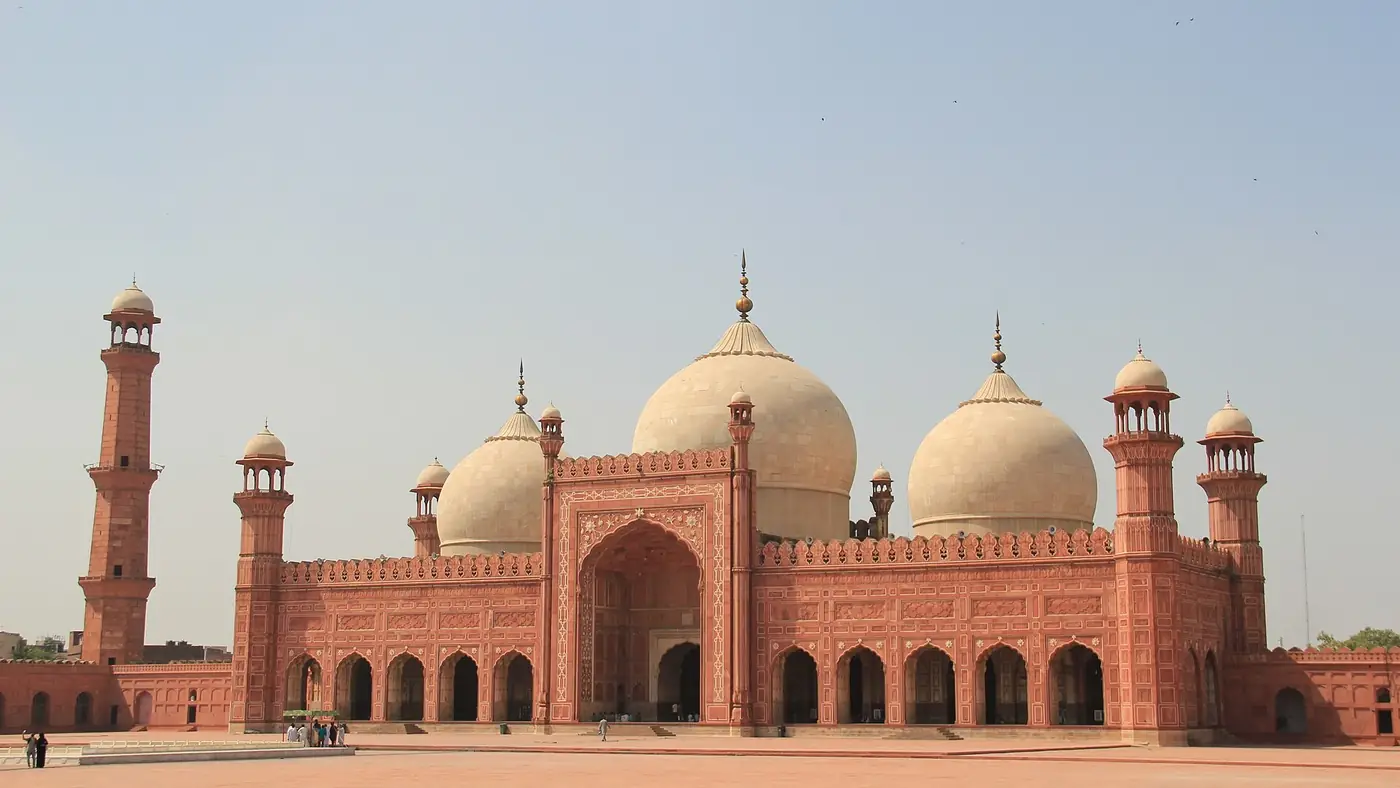
The prayer hall. Across the courtyard, under three white marble domes, the hall holds about 10,000 people. The facade is red sandstone with white marble inlay, and inside the ceilings and walls carry carved and painted stucco in Mughal floral patterns. Look up.
The minarets. Four tall minarets stand at the corners of the courtyard, with four smaller ones at the corners of the prayer hall.
Allama Iqbal's tomb. Outside, beside the steps, is the tomb of Allama Muhammad Iqbal. It is a short, quiet stop that most visitors combine with the mosque.
A short history
The Badshahi Mosque was commissioned by the Mughal emperor Aurangzeb and built in 1671–73 under the supervision of his foster brother Fidai Khan Koka, then governor of Lahore. It was the largest mosque of the Mughal era, and for more than 300 years the largest in the world.
Its later history was hard. During Sikh rule in the first half of the 19th century the courtyard was used as a stable for the army's horses, and under the British the mosque was kept as a garrison before it was returned to Muslim use. The building you see owes much to a long restoration begun in 1939, championed by Sir Sikandar Hayat Khan and completed in 1960.
Combining it with the fort and Fort Road
The Badshahi Mosque, the Lahore Fort and Hazuri Bagh share one great square, so they make a natural half-day together:
- Lahore Fort first, in the late morning or early afternoon, since it closes half an hour before sunset. Our guide to Lahore Fort tickets and timings has a route through the highlights.
- Hazuri Bagh, the garden between the two, with its white marble pavilion from Ranjit Singh's time.
- The Badshahi Mosque for the last hour of light.
- Dinner on Fort Road, with the floodlit domes in front of you.
If you have longer, come in through the old city on foot from Delhi Gate; our guide to the Walled City of Lahore covers the route.
Who it suits, and when to skip
The mosque suits almost every visitor to Lahore. It is free, it is central, and nothing else in the city gives the same sense of scale. Families with children, older parents and first-time visitors all get something from it.
A few cautions. The steps up to the gateway are steep and there is a long barefoot walk across the courtyard, which is hard for anyone with limited mobility and uncomfortable at midday in summer. Friday is the wrong day for sightseeing. And if you want quiet, avoid weekend evenings, when the square is crowded. For a trip that fits the mosque around everything else Lahore has, see our three-day Lahore itinerary, or tell us your dates and we will plan it for you.
Frequently asked questions
Is there an entry fee for the Badshahi Mosque?
No. Entry is free. You may give a small tip to the attendants who look after shoes at the entrance.
What are the Badshahi Mosque timings?
It is open daily from the morning until around the evening prayers. Sightseeing pauses during congregational prayers, and Friday between about 12 and 2:30 pm is best avoided.
Can women visit the Badshahi Mosque?
Yes. Women should wear loose clothes covering the arms and legs and cover their heads with a dupatta or scarf before entering.
Can non-Muslims visit the Badshahi Mosque?
Yes, visitors of all faiths are welcome outside prayer times, provided they dress modestly, remove their shoes and behave respectfully.
Is photography allowed inside the Badshahi Mosque?
Personal photographs are fine, but don't photograph people at prayer. Wedding shoots were banned in 2019, and professional filming needs permission from the Punjab Auqaf department, which manages the mosque.
Who built the Badshahi Mosque?
The Mughal emperor Aurangzeb, in 1671–73. Construction was overseen by his foster brother Fidai Khan Koka, the governor of Lahore.