Rohtas Fort is Sher Shah Suri's 16th-century fortress near Dina in Jhelum district, a UNESCO World Heritage Site since 1997 and an easy day out from Islamabad or Lahore. It sits about 16 km north-west of Jhelum and a few kilometres off the GT Road, roughly two to two and a half hours' drive from Islamabad. As a protected site it opens daily from early morning until half an hour before sunset, with a small ticket bought at the fort, and you need two to three hours on foot to see the main gates, the stepwells and the palace ruins of Haveli Man Singh and Rani Mahal.
The fort is huge, with walls wrapping a whole hilltop and a working village inside, so it helps to know what to look for. This guide covers the drive, the practical details, the gates and buildings worth your time, and a walking route that takes in the best of it.
| At a glance | |
|---|---|
| Where | Near Dina, about 16 km north-west of Jhelum |
| From Islamabad | About 2 to 2.5 hours by road |
| From Lahore | About 3 hours by the GT Road |
| Opening times | Winter from 8 am, summer from 7 am, until 30 minutes before sunset |
| Tickets | Bought at the fort; carry cash |
| Time needed | 2 to 3 hours |
| Best months | October to March |
| UNESCO listing | 1997 |
How do you get to Rohtas Fort?
Rohtas is reached from the GT Road (N-5) at Dina, between Gujar Khan and Jhelum. From Dina a local road runs south for several kilometres to the fort, crossing the Kahan (or Ghan) river on a bridge. Before the bridge was built, visitors had to cross the riverbed itself, and in the rains the fort could be cut off; that is no longer a problem.
- From Islamabad and Rawalpindi: down the GT Road through Rawat, Gujar Khan and Sohawa to Dina. Allow about two to two and a half hours, more if you leave in the Rawalpindi rush hour.
- From Lahore: up the GT Road through Gujranwala, Gujrat and Jhelum. About three hours in normal traffic; the Punjab tourism department's own Rohtas day trip allows three.
- By train: Dina has a railway station on the main line, a few kilometres from the fort. From there you need a rickshaw or taxi.
There is space to park outside the walls, and small stalls near the entrance sell drinks and snacks. There is nowhere to eat properly at the fort itself, so bring water and food, or plan lunch in Dina or Jhelum.
Opening times and tickets
Rohtas is managed by the Punjab Directorate General of Archaeology, which runs its protected sites and monuments from 8 am in winter and 7 am in summer, until 30 minutes before sunset, every day of the week. Museum rooms inside the fort may keep shorter hours.
You buy a ticket at the entrance. There are separate rates for Pakistanis and foreign nationals, and archaeology fees in Punjab have been revised in recent years, so we don't quote a figure. It is inexpensive for Pakistani visitors; carry cash. Foreign visitors should carry their passports.
Local guides are usually available near the gate. A good one saves you a lot of wandering and knows the stories behind each gate; agree the fee before you start.
A little history
Sher Shah Suri, who had driven the Mughal emperor Humayun out of India, began Rohtas in about 1541. It had two jobs: to block Humayun's return from the north-west, and to hold down the Gakhar tribes of the Potohar, who sided with the Mughals. The work was supervised by his minister Todar Mal.
It was barely used for its purpose. Sher Shah died in 1545, Humayun returned in 1555, and under the Mughals the fort lost its importance. It was never heavily rebuilt, and much of Sher Shah's work survives. UNESCO lists it as an exceptional example of early Muslim military architecture in Central and South Asia.
There is more on Sher Shah, Humayun and the Gakhars than we can fit here; this guide sticks to what you will see on the ground.
The walls and gates
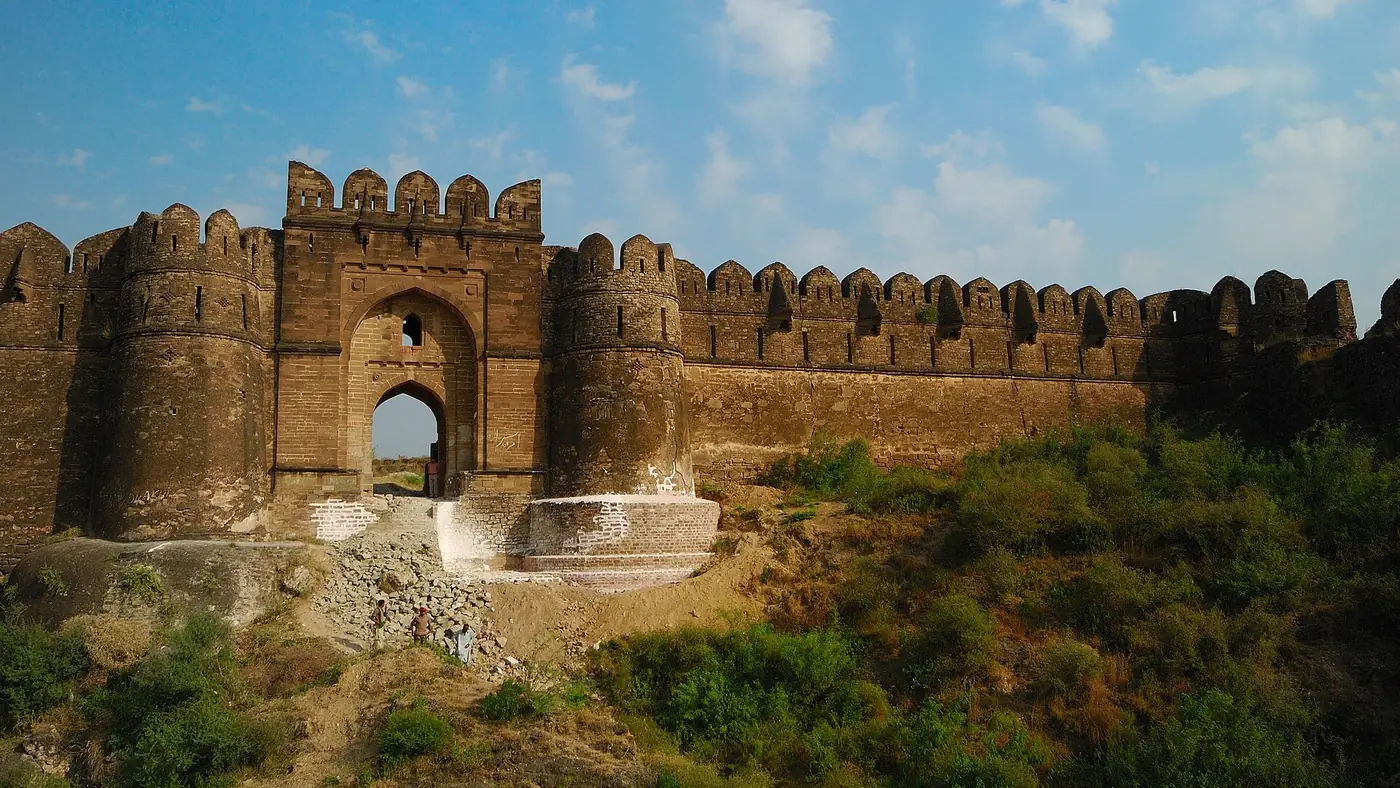
The first surprise is the size. The walls follow the edge of the hilltop for several kilometres, stand 10 to 18 metres high, and carry 68 bastions. Punjab's archaeology department counts 12 gates, all in grey dressed stone, and each has its own name and story. You will not see them all in one visit; these are the ones worth seeking out.
Sohail Gate
The grand ceremonial entrance, and a natural place to start. At over 20 metres high, it has fine carved stone decoration and is named after a local saint, Sohail Bukhari. A small museum on Sher Shah Suri and the fort is housed in the gate.
Kabuli Gate
Named because it faces north-west, towards Kabul. It is a double gate with a stepwell between its inner and outer parts, and the Shahi Masjid stands close by.
Shah Chandwali Gate
A double gate linking the main fort to the inner citadel, named after a saint said to have died while working on its construction.
Langar Khani and Talaqi gates
Langar Khani gave direct access to the citadel and was designed as a trap: anyone forcing it came under fire from the bastions around it. Talaqi Gate, about 15 metres high, carries a name associated in local tradition with bad luck.
Shishi Gate
Small, but look at its outer arch: the blue glazed tiles that give it its name are among the earliest examples of the technique in the region.
Khwas Khani and Gatali gates
Khwas Khani was the original entrance for the old road, named after one of Sher Shah's generals. Gatali Gate looks out towards the Gatali ford on the Jhelum river, the historic crossing towards Kashmir.
Inside the walls: palaces, stepwells and the mosque
Haveli Man Singh and Rani Mahal
In the north-west corner of the fort, an inner wall encloses the Andarkot, the citadel meant for the commander and his household. On its highest point stands Haveli Man Singh, named after Raja Man Singh, one of Akbar's generals, and added in the Mughal period. It is the only palace in the fort, and from up here you get the best view in Rohtas: the walls running away across the hills, the village below and the plain towards the Jhelum.
Close by is Rani Mahal, the queen's palace. It was built with four rooms, but only one survives: a small, tall, decorated chamber. Conservation work has been carried out on it, so what you can enter may vary.
The stepwells and the Shahi Masjid
With no river inside the walls, water came from baolis, stepwells cut deep into the rock. The largest, the central baoli, drops down long flights of steps to the water level and was built for the garrison and its animals. There is also a smaller royal baoli, with bathing chambers, and another by the Sar Gate. Take care on the steps: they are uneven and there are no railings.
The Shahi Masjid, near Kabuli Gate, is a small, finely decorated mosque with a prayer chamber of three domed bays and carved calligraphy. It is small, but worth the stop for its carving.
A walking route through the fort
Rohtas is spread over about 70 hectares, with rough paths, slopes and very little shade. A route that covers the highlights in two to three hours:
- Sohail Gate. Start here, look at the carving on both faces of the gate and visit the museum.
- Through the village. Follow the main lanes of Rohtas village towards the centre of the fort. About 4,000 people still live inside the walls, one reason Rohtas is called a living fort. Be discreet with your camera around homes.
- The central baoli. Walk down part of the way, carefully.
- Shahi Masjid and Kabuli Gate. See the mosque, then look out through the gate towards the west.
- Shah Chandwali Gate into the Andarkot. This double gate takes you into the citadel.
- Haveli Man Singh and Rani Mahal. Climb to the highest point for the view, and take your time here.
- Back by Langar Khani Gate or along a stretch of the walls, returning to Sohail Gate and the car park.
Parts of the walls are high and unrailed, and loose stone is common. Keep children close on the ramparts and in the baolis, and wear proper shoes.
When to go
October to March is the comfortable season, with mild, mostly clear days. From May to August the heat in Jhelum district is severe, and with almost no shade inside the fort, a midday visit is exhausting; if you must go in summer, arrive when the gates open. The monsoon, from July to September, brings humidity and slippery paths.
Weekdays are the quietest time to go. Weekends and public holidays bring families and school groups, mostly around the main gates.
Is Rohtas Fort worth visiting?
For anyone interested in history or architecture, very much so. It is one of the finest forts in Pakistan and, unlike the Lahore Fort, it is big and empty enough to feel like a real fortress rather than a museum. The drive is easy, and it pairs well with a night in Jhelum or with Mangla on the same day.
It suits people less well if they want a polished visitor experience: signage is limited, facilities are basic, and much of the fort is ruin rather than restored building. Small children and anyone who struggles with uneven ground will find the full walk hard. For them, Sohail Gate, the museum and a short walk into the village make a good shorter visit.
If you are planning a wider trip, our guide to day trips from Islamabad sets Rohtas alongside Taxila, Katas Raj and Khewra, and our travel guide covers the practical side of getting around Pakistan. For more on the site, the Punjab Directorate General of Archaeology keeps a page on the fort. And if you would like us to help plan the day, send us your dates.
Frequently asked questions
What are the timings of Rohtas Fort?
As a protected site under the Punjab archaeology department, it opens at 8 am in winter and 7 am in summer, and closes 30 minutes before sunset, every day. Museum rooms may keep shorter hours.
What is the Rohtas Fort ticket price?
Tickets are sold at the entrance, with different rates for Pakistanis and foreign nationals. Fees have been revised in recent years, so carry cash and check the rate at the gate.
How far is Rohtas Fort from Islamabad?
A little over 100 km by the GT Road, about two to two and a half hours by car. The turn is at Dina, between Sohawa and Jhelum.
Who built Rohtas Fort?
Sher Shah Suri, from about 1541, with the work supervised by his minister Todar Mal. It was built to block the return of the Mughal emperor Humayun and to control the Gakhar tribes.
How many gates does Rohtas Fort have?
The Punjab archaeology department counts 12. The best known are Sohail Gate, Kabuli Gate, Shah Chandwali Gate and Shishi Gate.
How long do you need at Rohtas Fort?
Two to three hours for the main gates, the stepwells, the Shahi Masjid and Haveli Man Singh. Allow a full half-day if you want to walk long stretches of the walls.