Chiniot, on the bank of the Chenab in central Punjab, is known across Pakistan for one thing: wood. The city has been a centre of fine woodcarving and furniture-making since the Mughal era, and that craft shows up everywhere, from a carved wooden mansion to the furniture bazaars that still supply homes across the country.
Chiniot is a compact town, and the best places to visit are close together, so most of what's worth seeing can be covered in a single day.
| At a glance | |
|---|---|
| Location | Chiniot, on the Chenab River, Punjab |
| From Faisalabad | About 38 km, under an hour |
| From Lahore | About 158 km, roughly 2.5 hours by road |
| Best for | A day trip combined with Faisalabad or a stop en route north |
| Known for | Woodcarving, furniture-making, Mughal-era architecture |
A bit of history
Chiniot is one of the older towns in this part of Punjab, and its position on the Chenab made it a trading stop for centuries before the Mughal-era buildings that draw visitors today were built. The Shahi Mosque and Omar Hayat Mahal date from very different periods, more than 250 years apart, but both were built by Chinioti men who had made their names elsewhere and put money into the city that raised them. That pattern — wealth earned outside Chiniot, spent on buildings inside it — is a big part of why the old town has such a dense concentration of fine architecture for its size.
Omar Hayat Mahal
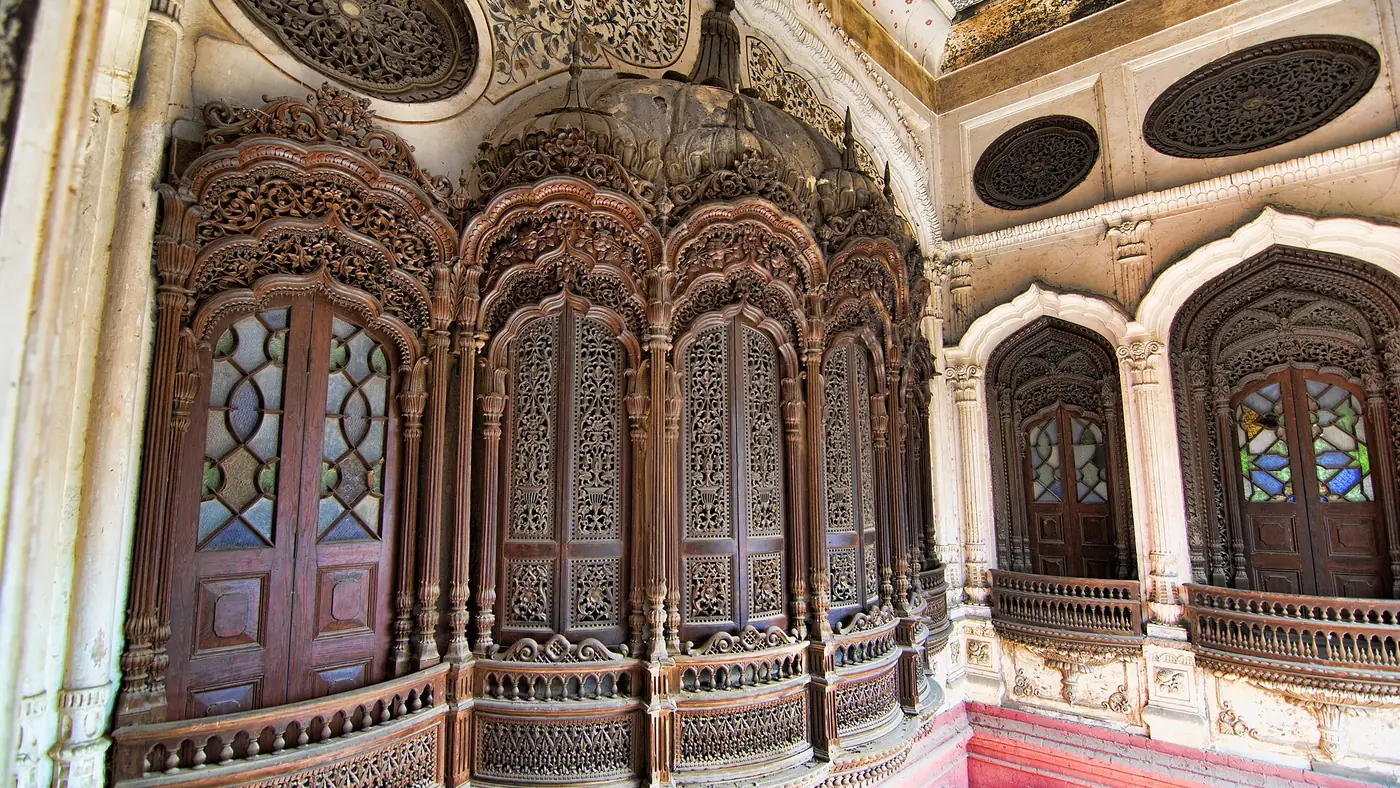
The single best reason to stop in Chiniot is Omar Hayat Mahal, a wooden haveli built between 1923 and 1935 by Sheikh Omar Hayat, a Chinioti businessman who made his fortune in Calcutta. It's a showcase of the city's woodcarving tradition: intricately carved wooden balconies, screens and facades on a scale rarely seen elsewhere in Punjab.
The building is one of Chiniot's most recognisable landmarks and is easy to combine with a walk through the old town around it. Give it thirty minutes to an hour, and look up at the balconies and screens as much as the main facade — much of the detail is in the upper storeys.
Shahi Mosque (Jamia Masjid)
The Shahi Masjid was built between roughly 1648 and 1655 by Nawab Saad Ullah Khan, a Chiniot native who served as prime minister under the Mughal emperor Shah Jahan. Built of stone quarried from the hills near the city, its style has been compared to the Jama Masjid in Delhi, with a domed prayer hall and fresco decoration inside.
It stands in the heart of the old town, close to the Shahi Bazaar, so it's a natural stop alongside the mahal and the market streets rather than a separate trip.
The hills above the Chenab
Chiniot sits beside a low outcrop of hills, part of the wider Kirana Hills range, rising to around 179 metres above the surrounding plain. They aren't a trekking destination, but a short climb gives a wide view over the city, the river and the surrounding farmland, and they're a popular local spot at sunset.
Chenab Park, maintained by the Tourism Development Corporation of Punjab, sits on the riverbank between Chiniot city and the nearby settlement of Chenab Nagar. It's a family-oriented green space for an evening walk or a picnic rather than a major attraction, and the old bridge over the Chenab nearby is a popular photo spot.
The furniture bazaars
Chiniot furniture is sold across Pakistan, but buying it where it's made means seeing workshops and showrooms clustered through the old city, where carvers still work with the same traditional patterns that decorate Omar Hayat Mahal. Even without buying anything, walking through the furniture bazaar gives a sense of the scale of the trade, from small family workshops to large showrooms fronting the main roads.
Getting to Chiniot
Most visitors reach Chiniot by road from Faisalabad, a drive of under an hour on the Faisalabad–Chiniot road, or directly from Lahore, about 158 km and roughly two and a half hours via the motorway and connecting roads. There's no airport in Chiniot itself, and the nearest useful rail connections run through Faisalabad, so a private car or hired taxi is the practical way to get here and move between the old town's sights, which are too spread out for all of them to be comfortably walkable in the summer heat.
Food in Chiniot
Chiniot has its own strong local food scene, built around the kind of hearty, slow-cooked dishes central Punjab is known for. It's worth eating a proper meal here rather than only snacking between sights — ask locally for whichever kunna house or old-town eatery is busiest that day, which is usually the best guide to where the food is good.
Planning a day in Chiniot
Chiniot works well as a day trip rather than an overnight stop for most visitors, since Faisalabad, less than an hour away, has a wider choice of hotels. A practical order for the day:
- Start at Omar Hayat Mahal and the old town streets around it, in the cooler part of the morning.
- Walk on to the Shahi Mosque, a short distance away.
- Browse the furniture bazaar if you're interested in the craft or looking to buy.
- End at the hills or Chenab Park in the late afternoon, timed for the view as the light softens.
Summers in central Punjab are hot and the old town has little shade, so an early start matters more here than a long itinerary. Our trip planning guide has more on building central Punjab stops into a wider itinerary.
Is Chiniot worth visiting?
For anyone interested in Mughal-era architecture or traditional craft, yes — the concentration of woodcarving in one small city is unusual, and Omar Hayat Mahal alone justifies the stop. As a general sightseeing destination on its own it's modest: this is a half-day to full-day trip, best paired with Faisalabad rather than treated as a standalone base.
Frequently asked questions
How far is Chiniot from Lahore?
About 158 km, roughly a two-and-a-half-hour drive by road.
Can Chiniot be visited as a day trip from Faisalabad?
Yes, easily. It's under an hour away, which is why most visitors base themselves in Faisalabad and treat Chiniot as a half-day or full-day excursion.
What is Chiniot famous for?
Woodcarving and furniture-making, a tradition going back to the Mughal era, along with landmark buildings like the carved wooden Omar Hayat Mahal and the 17th-century Shahi Mosque.
Is Omar Hayat Mahal open to the public?
It is a heritage building open for visits, though hours can vary, so it's worth checking locally or asking at the site on arrival rather than assuming a fixed schedule.
Is one day enough to see Chiniot?
For most visitors, yes. The mahal, mosque and bazaar are all close together in the old town, and a half to full day covers the main sights comfortably.
Is Chiniot good for buying furniture?
Yes, it's one of the main places in Pakistan to buy Chiniot-style carved wooden furniture directly from the workshops that make it, though prices and quality vary between sellers, so it pays to compare a few showrooms rather than buying at the first one you see.