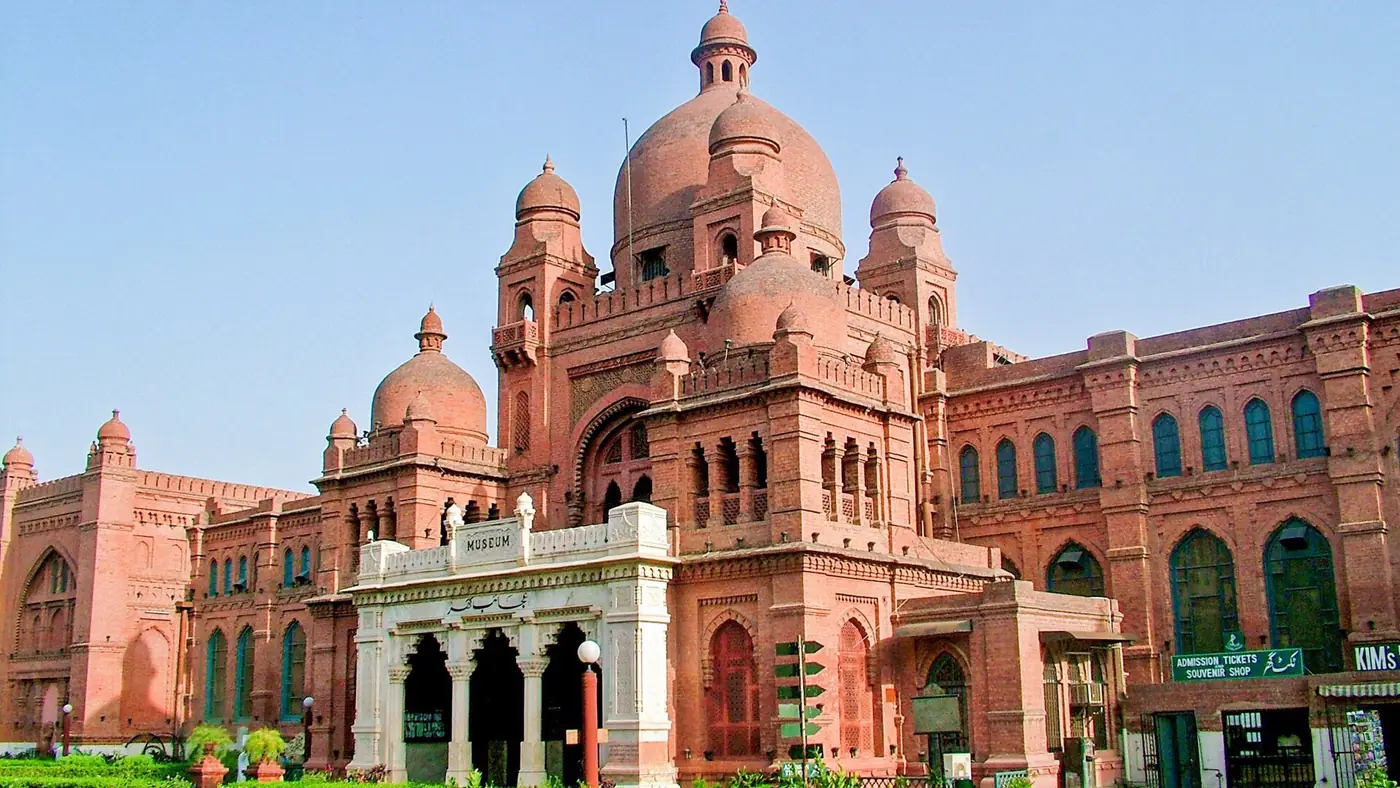
Lahore Museum, on the Mall Road, is Pakistan's largest museum and the best place in the country to see Gandhara-era Buddhist art in one place, including the celebrated Fasting Buddha. It opens at 9 am and closes at 4 pm in winter or 5 pm in summer, and is closed every Friday and on the first Monday of each month for maintenance. Two to three hours covers the main galleries at a comfortable pace.
| At a glance | |
|---|---|
| Location | The Mall (Shahrah-e-Quaid-e-Azam), opposite the National College of Arts |
| Hours | 9 am–4 pm winter, 9 am–5 pm summer |
| Closed | Every Friday, and the first Monday of each month |
| Entry fee | A modest charge for Pakistani visitors, higher for foreign nationals |
| Time needed | 2–3 hours for the main galleries |
| Highlight | The Fasting Buddha, Gandhara gallery |
Why visit Lahore Museum
Lahore Museum was founded in 1865, originally displayed at a different site to mark an exhibition, and moved into its current red-brick building on the Mall in 1894. The building itself is a notable example of Indo-Saracenic architecture, blending Mughal-influenced decorative elements with colonial-era planning, and is associated with the architect Bhai Ram Singh, who also worked on the National College of Arts next door; the two buildings share a similar architectural language, worth noticing if you visit both. It holds the largest and most important collection of Gandhara sculpture in Pakistan, alongside Mughal and Sikh-era miniature paintings, coins, textiles, arms and colonial-era exhibits, making it the single best introduction to the region's history before setting out to see the forts and shrines in person.
The Fasting Buddha
The museum's best-known object is the Fasting Buddha, a Gandhara-period sculpture from around the 2nd to 3rd century CE, excavated at Sikri in what is now Khyber Pakhtunkhwa. It depicts Siddhartha Gautama during his ascetic years, emaciated to the point where ribs and veins are carved in fine detail, and is regarded as one of the finest surviving examples of Gandhara art anywhere in the world. It sits in its own gallery, usually the first stop for most visitors and worth several minutes on its own.
Kim's Gun and the Kipling connection
Outside the main entrance stands the Zamzama, a huge cannon cast in Lahore around 1757, during the Durrani period, and one of the largest cannons of its kind to survive from that era. It is better known today as "Kim's Gun," after the opening scene of Rudyard Kipling's novel "Kim," in which the young protagonist sits astride it facing the museum, which the book calls the "Wonder House." The connection is not incidental: Rudyard Kipling's father, John Lockwood Kipling, was the museum's first curator, arriving in Lahore in 1875 to lead what is now the National College of Arts next door and staying involved with the museum's growth until 1893. The cannon and the story behind it are worth a few minutes before or after your visit.
The Gandhara gallery
Beyond the Fasting Buddha, the Gandhara gallery holds an extensive collection of stone and stucco Buddhist sculpture from sites across northern Pakistan, spanning roughly the 1st to 5th centuries CE, when the region sat at a crossroads of Greek, Persian, Indian and Central Asian artistic influence. This is the strongest single collection of its kind in the country and the main reason serious visitors to Lahore make time for the museum.
Other galleries worth your time
- Miniature paintings: Mughal and Sikh-court miniatures, including work associated with the Lahore school of painting
- Coins and numismatics: one of the museum's older and more specialist collections, tracing currency across two thousand years of regional history
- Textiles and decorative arts: Punjabi embroidery, shawls and Islamic calligraphy and manuscripts
- Arms and armour: Mughal and Sikh-period weapons, including pieces associated with Ranjit Singh's court
- Freedom Movement gallery: exhibits on the Pakistan movement and independence, useful context alongside a visit to Minar-e-Pakistan
Galleries and their contents shift periodically as the museum rotates exhibits and completes conservation work, so treat any specific room layout as a guide rather than a fixed map, and ask staff on arrival if you are short on time and want directions to a particular collection.
Tickets and timings
Entry is charged at a modest rate for Pakistani nationals, with students paying less again, and a considerably higher rate for foreign visitors; there is also typically a separate, small charge if you want to take photographs inside. Prices have changed more than once in recent years, so treat any figure you read, including this one, as approximate and check the ticket counter on the day.
The museum keeps seasonal hours: 9 am to 4 pm in winter and 9 am to 5 pm in summer, and it is closed every Friday as well as the first Monday of each month for maintenance. Plan around those two closures, since arriving on the wrong day is the most common way visitors miss it.
Planning your visit
Two to three hours is enough to see the Fasting Buddha, the Gandhara gallery, the miniatures and one or two other collections without rushing. If you are combining it with the rest of the Mall and the old city in one day, put the museum in the morning while you are fresh, since the galleries reward slow looking rather than a quick walk-through. Our Lahore itinerary fits it into a wider day-by-day plan alongside the fort, the Badshahi Mosque and the food streets.
Getting there
The museum sits on the Mall, within walking distance of several other colonial-era buildings and a short rickshaw or car ride from the Walled City. Parking is available on site, and it is also reachable from the Metrobus route along the Mall corridor.
Frequently asked questions
What are Lahore Museum's opening hours?
9 am to 4 pm in winter and 9 am to 5 pm in summer. It is closed every Friday and on the first Monday of each month.
How much does it cost to enter Lahore Museum?
Pakistani visitors pay a modest fee, with a lower student rate, and foreign visitors pay considerably more. Prices have changed in recent years, so check the current rate at the ticket counter.
What is the most famous object in Lahore Museum?
The Fasting Buddha, a Gandhara-period sculpture from around the 2nd to 3rd century CE, depicting Siddhartha Gautama as an emaciated ascetic. It is one of the finest surviving Gandhara sculptures anywhere.
How much time should I allow for Lahore Museum?
Two to three hours covers the main galleries comfortably. Add more time if you are especially interested in Gandhara art or miniature painting.
Is Lahore Museum suitable for children?
Yes, though younger children may find the pace slow compared with more interactive attractions. The scale models, weapons gallery and large sculptures tend to hold their attention best.
Is Lahore Museum near the Lahore Fort and Badshahi Mosque?
It is a short drive or rickshaw ride from the old city, not within easy walking distance. Most visitors treat it as a separate stop on the Mall rather than part of the same walk.