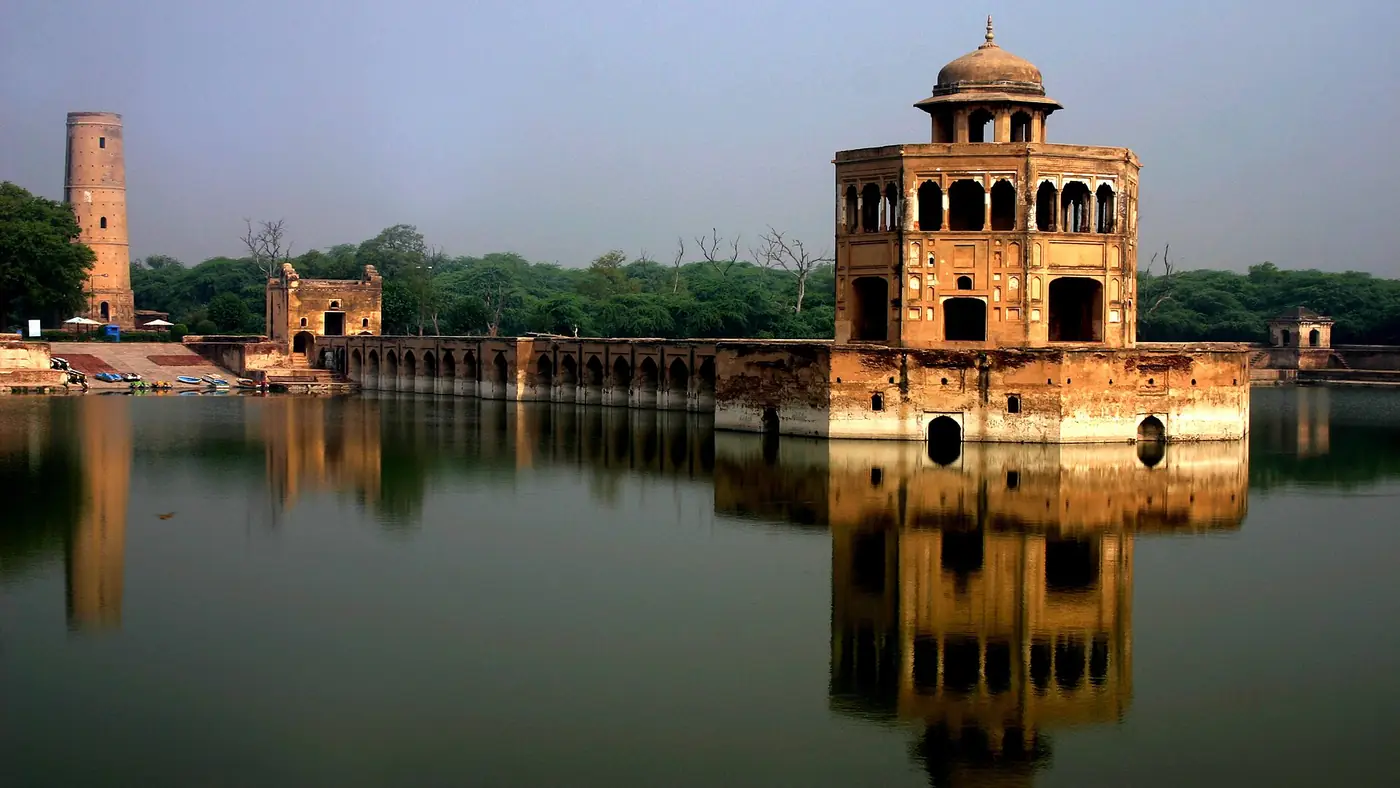
Hiran Minar, in Sheikhupura about 40 km from Lahore, is a Mughal-era brick tower and water tank built by Emperor Jahangir in memory of his pet antelope. It's one of the more unusual Mughal monuments in Punjab, built not to commemorate a person or a battle but an animal, and today it's a popular half-day trip from Lahore for its lake, boating and the tower itself.
This guide covers the history, what's on site, and how to plan a visit.
| At a glance | |
|---|---|
| Location | Sheikhupura, about 40 km northwest of Lahore |
| Built | Around 1606, expanded around 1620 |
| Built by | Emperor Jahangir; expanded under Shah Jahan |
| What's on site | The minaret, a large water tank, an octagonal pavilion, boating |
| Entry fee | A modest ticket price applies; treat any figure you read as approximate |
| Best time | October to March |
The story behind the name
Hiran Minar means "the deer tower." Jahangir kept a pet antelope named Mansraj at a hunting reserve here, and when the animal died, he had a tower built in its memory around 1606. It's an unusual gesture even by Mughal standards — most surviving Mughal monuments in Pakistan mark rulers, saints or victories, not pets — and it says something about the personal, almost sentimental side of Mughal court life that doesn't often survive in stone elsewhere.
Jahangir's son and successor, Shah Jahan, later expanded the site, adding a large rectangular water tank with an octagonal pavilion, or baradari, at its centre around 1620, connected to the minaret by a causeway. What visitors see today is really this combined complex: the original tower plus the later tank and pavilion.
The site began life as a hunting reserve, one of several the Mughal court maintained around Lahore, which was then the empire's seasonal capital under Jahangir. That context matters for understanding why a monument to a pet animal made sense here in a way it might not elsewhere: Hiran Minar sits within what was once managed parkland for royal hunting, not a city or a shrine complex, and the deer tower was as much a marker of that royal hunting ground as a personal memorial.
The tower and the tank
The minaret itself is a tapering, four-storey brick tower — a fifth storey that once topped it no longer survives — standing at around 95 feet. It's climbable in principle, though the condition of the interior stairs can vary, so treat access on the day as something to check on site rather than assume.
The water tank is the more immediately striking part of the complex: a large rectangular pool with the pavilion rising from an island at its centre, reached by a causeway. In good light, with the tower reflected in the water, it's one of the more photogenic Mughal-era sites within easy reach of Lahore.
The pavilion itself, though smaller than the grand garden pavilions at Shalimar or in Lahore Fort, follows the same architectural language: an octagonal plan, arched openings on each face, and a position designed to be seen from, and reflected in, water. It's worth walking the full causeway out to it rather than viewing it only from the tank's edge — the perspective back toward the tower from the pavilion is one of the better views on site.
Boating
Pedal boats and rowing boats are available on the tank for a modest additional fee, and this is one of the main reasons Hiran Minar draws families and groups rather than only history-focused visitors. A slow circuit of the tank by boat, with the pavilion and tower in view, is the highlight of a visit for many people, more than the historical detail of the buildings themselves.
Planning your visit
Hiran Minar suits a half-day trip from Lahore rather than a full day on its own:
- Leave Lahore in the morning, allowing an hour to two hours depending on traffic — it's about 40 km, but the route runs through busier local roads rather than open motorway for part of the way.
- Spend an hour to ninety minutes on site: walking the causeway and pavilion, a look at the tower, and boating if you want it.
- Bring cash for the entry ticket and boating, since fees for both have been reported at modest but inconsistent amounts across different sources, and prices do change.
- Combine it, if you like, with other stops in Sheikhupura or a wider central Punjab day, since Hiran Minar alone is unlikely to fill a full day for most visitors.
Our trip planning guide has more on fitting a stop like this into a wider Punjab itinerary, and the travel guide covers general road and transport advice for the region.
When to go
Central Punjab's summers are hot, and the open ground around the tank has limited shade, so October to March is the more comfortable season, with cooler mornings making the walk around the water tank far more pleasant. A summer visit is still possible, but plan for an early morning or late afternoon start rather than midday.
Weekends and public holidays bring larger local crowds, particularly for boating, so if you'd rather have the site to yourselves a weekday morning is the better choice. Photography around the tank is best in the first couple of hours after sunrise or in the late afternoon, when the low light picks out the brickwork of the tower rather than flattening it under a midday sun.
Is Hiran Minar worth visiting?
For anyone doing a Lahore-based trip with an interest in Mughal architecture, or families looking for an easy half-day out with some open water and boating, yes — it's a manageable, low-effort excursion with a genuinely unusual story behind it, and one that's easy to fit around an early start or a late-afternoon return without committing a full day to it. It's not a large or dramatic site compared with Lahore's major forts and gardens, so keep expectations proportionate: this is a pleasant half-day stop, not a headline destination in its own right.
Frequently asked questions
How far is Hiran Minar from Lahore?
About 40 km, typically an hour to two hours by road depending on traffic and route.
What is Hiran Minar famous for?
A Mughal-era brick tower built by Emperor Jahangir in memory of his pet antelope, along with a large water tank and central pavilion added later under Shah Jahan.
Is boating available at Hiran Minar?
Yes, pedal boats and rowing boats operate on the water tank for an additional fee on top of the entry ticket.
Is there an entry fee for Hiran Minar?
Yes, a modest ticket fee applies, though reported amounts vary between sources, so carry small cash and expect to pay whatever is posted at the gate.
How much time do you need at Hiran Minar?
An hour to ninety minutes covers the tower, tank and pavilion at a relaxed pace, longer if you add boating or combine it with other stops in Sheikhupura.
Can you climb the tower at Hiran Minar?
It's sometimes possible, but the condition of the internal stairs can vary and access isn't guaranteed, so treat it as something to ask about on arrival rather than a fixed part of the visit.